
Quick answer: AI is changing SEO in 2026 by shifting the primary goal from ranking on a results page to being cited inside AI-generated answers. Google AI Overviews, ChatGPT, Perplexity, and Gemini now answer queries directly — meaning your content must be structured for citation and visibility inside AI responses, not just for traditional click-throughs.
If your traffic strategy is still built around ranking in the top three organic positions, you are optimizing for a search experience that a large and growing share of your audience is no longer using.
This is not a prediction about where search is heading. It is a description of where it already is. In 2026, AI-generated answers are the first thing millions of users encounter — before they see a single organic result. Google AI Overviews appear at the top of the page for a significant portion of informational queries. ChatGPT and Perplexity handle research tasks that would have gone directly to Google two years ago. Gemini is integrated into Google Search, Google Workspace, and Android.
The question is not whether this affects you. It does. The question is what to do about it — and how fast.
What Is Driving the AI Search Shift in 2026?
Three forces converged to produce the current landscape.
Large Language Models became capable enough to answer questions reliably. Models like GPT-4o, Gemini 1.5 Pro, and Claude 3 now synthesize information from multiple sources into coherent, structured answers. For informational queries — definitions, how-tos, comparisons, explanations — they are often faster and more direct than browsing five separate web pages.
Google responded by integrating AI directly into search. AI Overviews — previously called Search Generative Experience (SGE) — are now a default feature of Google Search across multiple markets. They generate a summarized answer at the top of the results page, pulling from sources Google’s systems deem authoritative, well-structured, and entity-rich. Clicks to cited sources exist, but the dynamic is fundamentally different from traditional organic click-throughs.
Standalone answer engines built real audiences. Perplexity processed 780 million queries in May 2025 — growing at over 20% month-on-month according to CEO Aravind Srinivas. ChatGPT’s search functionality is used daily by a significant portion of its user base for research. These platforms do not rank web pages — they synthesize content and cite sources. Appearing in those citations is a new, distinct form of search visibility with its own rules.
How Do Google AI Overviews Change the Rules for SEO?
AI Overviews appear most frequently for informational queries — the category that has historically driven the majority of organic traffic for content sites, blogs, and media publishers.
The practical effect has two sides.
Clicks to non-cited pages decrease. When a user’s question is answered inside the AI Overview, the motivation to click an organic result weakens. Zero-click behaviour — already rising from featured snippets and People Also Ask boxes — accelerates further. This is not theoretical. Publishers with high concentrations of informational content are seeing it in their analytics now.
I started seeing this pattern across multiple client monitoring dashboards in 2024 — not one account in isolation, but several simultaneously across different sectors. The first metric to move was the impressions-to-CTR ratio: impressions held or even increased as Google crawled content for AI Overview sourcing, while CTR dropped because the answer was served directly above organic results. Seeing that divergence across accounts at the same time made it clear this was a structural shift, not a site-level anomaly. That pattern is now the first thing I check when a client flags unexpected traffic movement on informational content.
Being cited inside AI Overviews creates a new traffic source. Pages cited in AI Overviews receive a source link. These clicks tend to come from users who want to verify or go deeper — higher intent than average organic visitors. Getting cited is both a visibility goal and a traffic strategy in its own right.
The critical structural difference from traditional SEO: Google’s selection logic for AI Overview citations is not identical to its ranking algorithm for ten blue links. Content that ranks at position one is not guaranteed to be cited. Content that is well-structured, entity-rich, and answers a specific question directly and concisely has a significantly higher probability of citation — even from position four or five. Structure beats position in this game.
How Do ChatGPT, Perplexity, and Gemini Affect Your Traffic?
Google AI Overviews are only part of the picture. A growing share of information-seeking now happens entirely outside Google.
ChatGPT with web browsing enabled regularly surfaces and cites current web content. When a user asks “what’s the best approach to internal linking for AI SEO in 2026,” ChatGPT searches, reads, synthesises, and names its sources. If your content appears as a source, you get cited — and your brand appears in front of a highly engaged, research-oriented user.
Perplexity is built entirely around this citation model. Every response names sources. Every response is a potential content citation opportunity. Perplexity’s audience skews toward analysts, researchers, and senior professionals — a high-value segment for most B2B content and agency-focused publishers.
Microsoft Copilot integrates with Bing and surfaces web content inside Office applications, Windows, and Edge. This extends the reach of AI-driven content discovery beyond traditional search surfaces entirely.
The implication: search visibility in 2026 is not a single metric or a single platform. It is a portfolio of presences across multiple AI surfaces, each with different citation logic, different audience behaviour, and different content format preferences.
What Is the Difference Between SEO, AEO, and GEO?
Three disciplines now sit under the broader umbrella of search visibility strategy. Understanding how they interact is the foundation of any effective AI-era content operation.
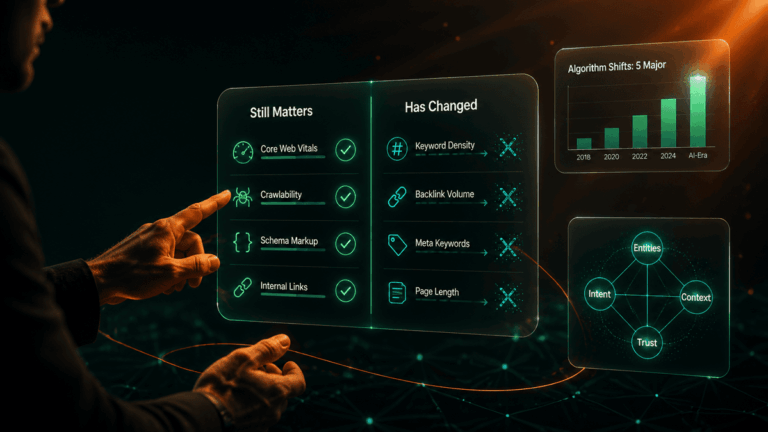
SEO (Search Engine Optimization) remains relevant for driving organic traffic from traditional ranked results. Technical site health, backlinks, topical authority, and on-page optimisation still matter — particularly for commercial and transactional queries where AI Overviews appear far less frequently than on informational queries.
Answer Engine Optimization (AEO) is the practice of structuring content to be surfaced and cited inside answer engines — including Google AI Overviews, featured snippets, and the answer layer of AI assistants. AEO focuses on direct-answer content blocks, schema markup, FAQ sections, and entity clarity that makes your content extractable.
Generative Engine Optimization (GEO) is the practice of structuring content so that Large Language Models can understand, summarise, and accurately cite it inside AI-generated responses. GEO involves information architecture, entity definition, atomic answers, and content density — making your content the most reliable, citable source on a given topic across all AI surfaces.
These disciplines are not mutually exclusive. The most resilient content operations in 2026 run all three in parallel. For a complete breakdown of how they interact and what your content architecture needs to look like for each, see the GEO & AEO Playbooks.
5 Things Every SEO Must Do Differently in 2026
These are not theoretical adjustments. They are specific, structural changes that determine whether your content is cited or ignored by AI systems.
- Add a direct answer block to every article. Place a 40–60 word, plain-language answer to your target question within the first two paragraphs. No preamble. No context-setting. No “in this post we will explore…” AI systems extract the most direct, self-contained answer available — if you do not provide one, a competitor’s content gets cited instead.
- Use question-based H2 and H3 subheadings. Structure your content around the exact questions users and AI assistants ask. “How does Google AI Overviews affect click-through rates?” is a better subheading than “AI Overviews Impact.” The question format maps directly to how Large Language Models decompose and match content to user queries.
- Name your entities explicitly. LLMs build understanding from entity relationships. Naming tools, platforms, organisations, and concepts precisely — rather than using pronouns and vague references — makes your content more reliably extracted and attributed. “Google AI Overviews” is better than “Google’s AI feature.” “Generative Engine Optimization (GEO)” is better than “the new kind of SEO.”
- Add a FAQ section with 5–6 specific questions. FAQs are one of the most reliably extracted content formats across AI citation surfaces. Each Q&A pair should be self-contained, specific, and under 100 words. Pair FAQ sections with FAQPage schema markup to signal extractable structure to both Google and third-party LLMs that index your content.
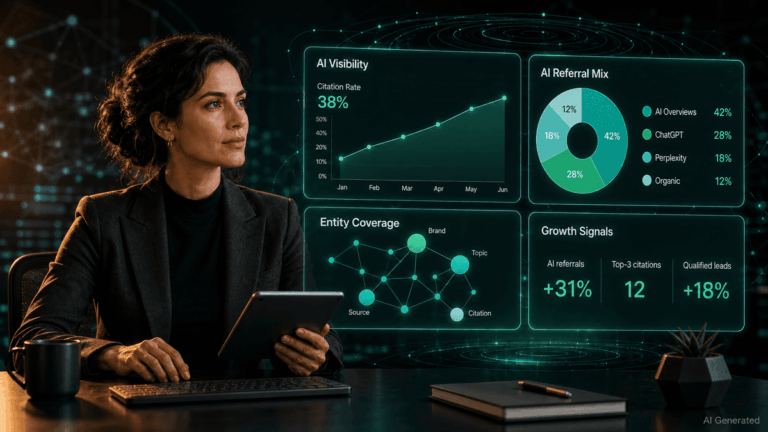
- Track AI referral traffic as a separate segment. Set up GA4 segments to measure direct referrals from ChatGPT, Perplexity, Gemini, and other AI surfaces. This data shows which of your existing content is already being cited — and should directly inform your GEO content architecture priorities. You cannot optimise what you are not measuring.
In practice, Perplexity is the cleanest signal to start with — it passes referrer headers reliably, so perplexity.ai / referral appears in GA4 without any custom configuration, though volumes across most accounts are still in the dozens to low hundreds of sessions per month. ChatGPT dominates volume but hides 60–70% of it: most visits arrive as Direct because it strips referrer headers, making the visible chatgpt.com / referral line a significant undercount of reality. Quality compensates for the tracking friction — on the accounts where I can attribute it, AI-referred traffic consistently converts at a meaningfully higher rate than organic search, and Perplexity-referred users tend to stay noticeably longer per session. That engagement profile is why this channel warrants serious measurement now, well before the volume becomes obvious.
What Does This Mean for Agencies, In-House Teams, and Solo Creators?
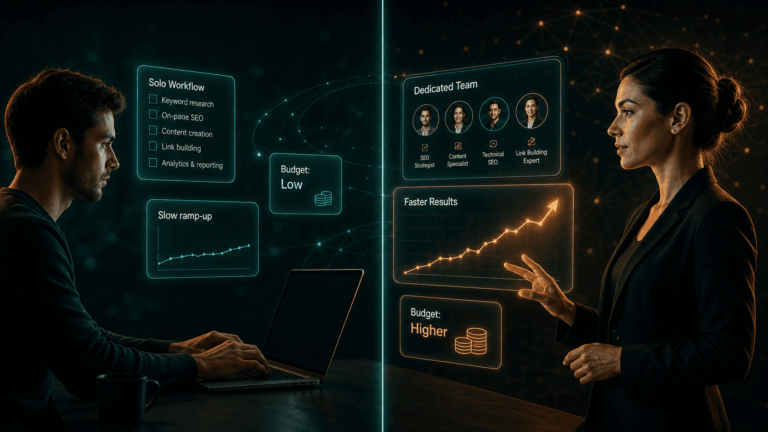
For agency owners: Clients are already asking about AI Overviews and traffic shifts. The agencies that grow through 2026 are those that can audit for AI search readiness, restructure content for GEO and AEO citation, and report on citation visibility alongside traditional rank tracking. This is an opportunity to expand your service offering and justify stronger retainer value — but only if you build the methodology before your clients start asking for it.
Across my client accounts, the disruption has landed very differently by sector. Energy was hit hardest and required a full content rebuild — compliance-heavy, jargon-dense pages were never citation-ready, and when AI Overviews appeared on queries like “how does a heat pump tariff work,” Google cited government and consumer protection sources instead. E-commerce needed only a partial rebuild: spec tables and buying guides survived, but thin category page copy was displaced entirely — Google has also visibly protected transactional queries to preserve ad revenue, giving e-commerce clients more runway. Automotive is still the preemptive opportunity: AIO coverage remains low on local and transactional queries, but the informational gap on EV comparisons and leasing breakdowns is wide open and unclaimed.
For in-house SEO and content leads: Leadership will conflate any organic traffic shift with an “AI penalty.” Your job is to reframe the measurement conversation before it becomes a defensive one. Shift reporting to include citation visibility, AI referral traffic, and brand mention frequency across AI surfaces alongside position data. Build the dashboard that tells the full story before you are asked to explain a number that looks bad in isolation.
This conversation is now a regular part of client calls. A traffic drop looks identical in GA4 whether the cause is an algorithm update, seasonality, or AI Overview displacement — one line moving down. What changed the diagnostic process was building a parallel reporting layer: AI Overview impression share, referral sessions from perplexity.ai and chatgpt.com, and brand mention frequency in AI responses alongside traditional rank data. When you can show that organic CTR dropped but AI referral sessions are growing and brand visibility in AI responses is increasing, the conversation moves from blame to strategy. Without that second layer, every traffic dip becomes an argument instead of a diagnosis.
For solo creators and bloggers: High-quality, specific, well-structured content from individual practitioners is exactly what AI models prefer to cite. Generic content farms produce the broad, shallow content that AI Overviews are designed to replace. Deep, opinionated, practitioner-first content — the kind that takes genuine expertise to produce — is harder to summarise away and more likely to be cited as a named source. Your positioning is an advantage here, not a liability.
Stay Ahead of AI Search.
Weekly AEO, GEO & AI SEO intelligence for marketers who want their content cited by AI. No fluff.
Frequently Asked Questions
The Bottom Line
AI is not replacing SEO. It is adding two new disciplines — AEO and GEO — on top of it, each with specific structural requirements and distinct citation logic. The practitioners who navigate 2026 successfully are those who start applying those requirements to their content now, before they are forced to explain a traffic decline to a client or a leadership team.
The next step: read the SEO vs AEO vs GEO complete breakdown for the full framework on how these three disciplines interact and what your content architecture needs to look like across each one. Or audit your current site against the AI Search Readiness Checklist to see exactly where the gaps are.
Written by
AEO Insider Editorial Team
We help modern marketers and operators get their content cited by AI, discovered in search, and wired into scalable growth systems. Our collective focus is entirely on the cutting edge of AEO, GEO, and AI-native SEO.
ABOUT AEO Insider →