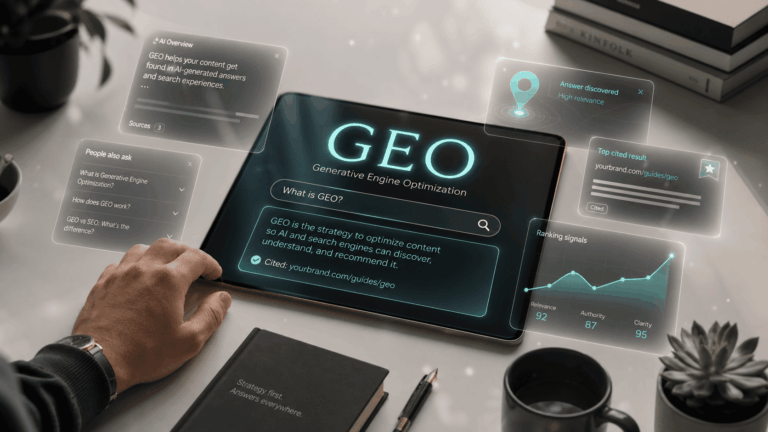
Quick answer: SEO (Search Engine Optimization) drives visibility in traditional ranked search results. AEO (Answer Engine Optimization) drives citation inside answer engines like Google AI Overviews and featured snippets. GEO (Generative Engine Optimization) drives citation inside AI-generated responses from Large Language Models like ChatGPT, Perplexity, and Gemini. In 2026, a complete search visibility strategy requires all three.
The terminology has multiplied faster than the explanations. SEO professionals are being asked about AEO by clients who read it in a newsletter. GEO appears in job descriptions without a clear definition. Executives want an “AI search strategy” without knowing how it differs from what their team already does.
The confusion is understandable. All three disciplines share the same ultimate goal — making your content visible and discoverable — but they operate on different surfaces, use different signals, and require different structural approaches to content.
This article defines each discipline precisely, explains how they interact, and gives you a clear framework for deciding where to focus your effort first. If you have not read the context on why AI is forcing this shift, start with How AI Is Changing SEO in 2026.
What Is SEO (Search Engine Optimization) in 2026?
Search Engine Optimization is the practice of improving a website’s visibility in traditional search engine results pages — primarily Google and Bing — through technical site health, content quality, topical authority, and link acquisition.
In 2026, SEO has not disappeared. It has narrowed in scope. The query categories where traditional ranked results still dominate are:
- Transactional queries — “buy noise-cancelling headphones,” “AI SEO audit service pricing”
- Navigational queries — “Ahrefs login,” “Semrush keyword tool”
- Local queries — “SEO agency near me,” “content strategist London”
- Commercial investigation queries — “best AI writing tools for agencies,” “Surfer SEO vs Clearscope”
These query types see far fewer AI Overviews than informational queries, and they drive higher-intent traffic. SEO remains the primary discipline for capturing this segment.
In practice, the “transactional equals safe” assumption holds less reliably than expected. Across client monitoring dashboards, automotive comparison queries like “RAM 1500 vs F-150” triggered AI Overviews 78.9% of the time despite clear commercial intent. In e-commerce, pure buy queries stayed mostly protected — under 13% AIO presence — but “best [product]” queries hit an 83% trigger rate, displacing category pages that had ranked stably for years. Energy regulatory and tariff queries showed the same unexpected exposure. The pattern now applied across all accounts: it is not transactional versus informational anymore. If Google judges a query to need synthesis, an AI Overview appears — intent classification alone is not the deciding factor.
Where SEO has lost ground is informational TOFU content — definitions, how-to guides, explainers, and comparisons. AI Overviews now answer a significant share of these queries on-page, reducing click-through to organic results for content that is not cited in the AI summary itself.
What Is Answer Engine Optimization (AEO)?
Answer Engine Optimization (AEO) is the practice of structuring content to be surfaced and cited inside answer engines — platforms and features that generate direct answers to user queries rather than returning a list of links.
The primary AEO surfaces in 2026 are:
- Google AI Overviews — the AI-generated summary that appears above organic results for informational queries
- Google Featured Snippets — the extracted paragraph, list, or table shown at position zero
- People Also Ask boxes — expandable Q&A results drawn from indexed content
- Voice search results — spoken answers delivered by Google Assistant and Siri, pulled from structured content
AEO is not a new concept — featured snippet optimisation has existed for years. What has changed is scale and stakes. Google AI Overviews appear for a far larger share of queries than featured snippets ever did, and they pull from multiple sources simultaneously, creating both a citation opportunity and a displacement risk for content that is not structured for extraction.
What AEO requires structurally:
- Direct answer blocks at the top of each article (40–60 words)
- Question-based H2 and H3 subheadings that mirror user query phrasing
- FAQ sections with self-contained Q&A pairs
- FAQPage and Article schema markup
- Concise, entity-rich definitions early in the content
What Is Generative Engine Optimization (GEO)?
Generative Engine Optimization (GEO) is the practice of structuring content so that Large Language Models (LLMs) can understand, accurately summarise, and cite it inside AI-generated responses.
The primary GEO surfaces in 2026 are:
- ChatGPT with web browsing enabled — searches and cites current web content in responses
- Perplexity — a dedicated answer engine that cites every source in every response
- Google Gemini — integrated into Search, Workspace, and Android with web-grounded responses
- Microsoft Copilot — Bing-powered AI assistant integrated across Office and Windows
- Claude — Anthropic’s assistant, increasingly used for research with web access
GEO operates at a deeper level than AEO. Where AEO focuses on being extracted by a structured retrieval system (Google’s indexing), GEO focuses on being understood and attributed by a probabilistic language model that synthesises information from across many sources.
What GEO requires structurally:
- Explicit entity naming — define every concept, tool, person, and organisation clearly
- Atomic answers — self-contained, complete answers within each section that do not require surrounding context to make sense
- Information density — more specific facts, examples, and data per paragraph than generic content
- Consistent internal entity relationships — use the same terminology throughout; avoid synonym variation that confuses LLM entity resolution
- External citations — link to authoritative sources (Semrush studies, Google documentation, peer-reviewed data) to signal credibility to models that weight sourcing
How Do SEO, AEO, and GEO Differ From Each Other?
The clearest way to understand the three disciplines is by their primary surface, primary signal, and primary content requirement.
| Discipline | Primary surface | Primary signal | Core content requirement |
|---|---|---|---|
| SEO | Google / Bing ranked results | Backlinks, topical authority, technical health | Comprehensive, well-structured content on a specific topic |
| AEO | AI Overviews, Featured Snippets, PAA | Direct answer structure, schema markup, entity clarity | Short, self-contained answer blocks; FAQ sections; structured data |
| GEO | ChatGPT, Perplexity, Gemini, Copilot | Entity explicitness, information density, cited sourcing | Atomic answers, explicit entity definitions, external citations |
The important observation: the content improvements that serve AEO — direct answers, question-based structure, schema markup — also improve GEO performance. And the topical authority built through strong SEO creates the trust signals that both AEO and GEO systems rely on when selecting which sources to cite.
They are not competing disciplines. They are additive layers of the same content operation.
How Do SEO, AEO, and GEO Work Together?
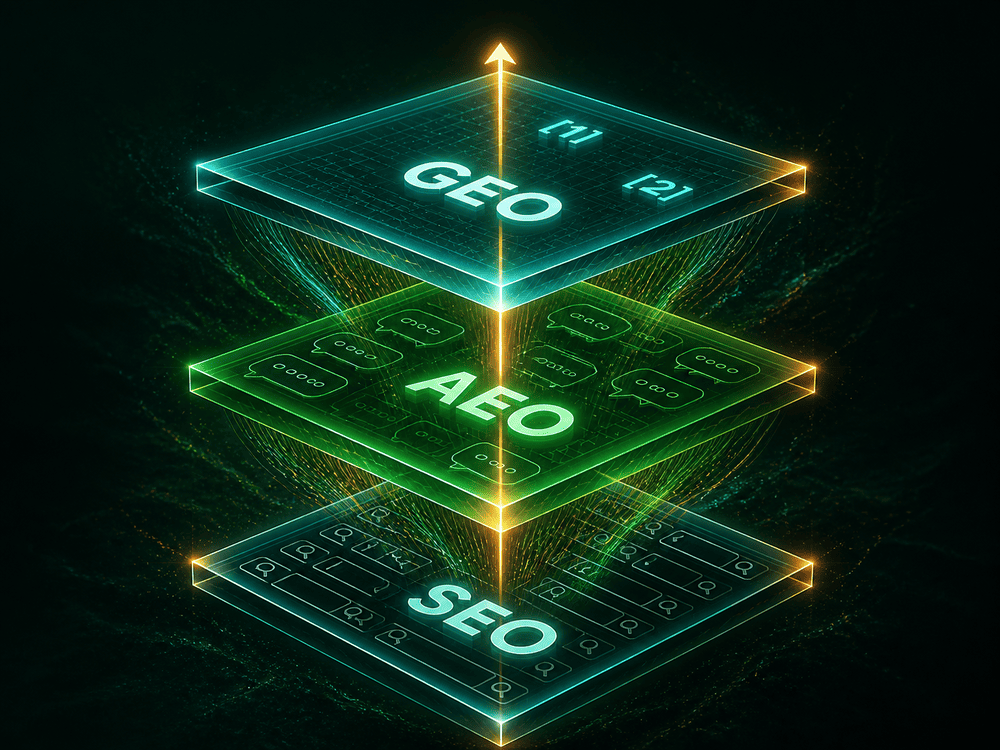
Think of the three disciplines as concentric circles of search visibility, each requiring a different layer of content optimisation.
SEO builds the foundation. Without topical authority, technical site health, and a credible link profile, your content is unlikely to be indexed reliably or trusted by any search or AI surface. SEO is still the base layer that makes everything else possible.
AEO extends that foundation to answer engine surfaces. Once your content is well-indexed and authoritative, adding direct answer blocks, question-based subheadings, FAQ sections, and schema markup makes it extractable by Google’s AI Overview system and featured snippet algorithm. This is the second layer — architectural changes that adapt existing strong content for AI-generated results pages.
GEO extends visibility to standalone AI platforms. Content that already performs well for SEO and AEO has a structural head start for GEO — it is well-organised, entity-rich, and clearly written. The additional GEO layer adds explicit entity naming, atomic answer formatting, external citations, and information density that makes content reliably attributable by Large Language Models operating outside of Google’s ecosystem entirely.
A content operation running all three layers simultaneously is more resilient to any single platform’s algorithm changes, more visible across a wider range of user discovery surfaces, and more likely to appear as a named, cited source inside AI-generated answers — which is where brand authority is increasingly built in 2026.
Which Should You Prioritise First: SEO, AEO, or GEO?
The answer depends on your current situation, not a universal rule.
If your site has strong organic traffic but is seeing informational content decline: prioritise AEO. Audit your highest-traffic informational articles and retrofit them with direct answer blocks, question-based subheadings, and FAQ sections. Most of the structural work can be done inside existing content without a full rewrite.
If your site is new or has limited authority: prioritise SEO as the foundation. Without topical authority and indexing credibility, AEO and GEO optimisations have no base to build on. Publish consistently in your pillar categories, build internal linking depth, and earn external citations before adding the AEO and GEO layers.
If you serve a B2B or research-oriented audience: prioritise GEO in parallel with AEO. Perplexity and ChatGPT are used heavily by analysts, researchers, and senior decision-makers — exactly the audience that B2B content sites want to reach. Being cited in those surfaces reaches your target audience in their actual research workflow.
The sector split across client accounts makes this concrete. Energy is the strongest B2B signal — procurement managers and sustainability officers use Perplexity to research tariff structures and supplier comparisons before engaging a sales page. AI referral sessions run at 0.2–0.6% of total volume but convert at 3.1x the rate of standard Google organic because those users arrive pre-qualified. Tourism is different: Perplexity accounts for 6.3% of AI-referred leads, with direct booking inquiries from users citing it as their research tool. E-commerce and automotive remain primarily a discovery play — ChatGPT referrals represent under 0.2% of e-commerce sessions and underperform every traditional channel on direct conversion. The framing that lands with clients: GEO is not a traffic channel yet. It is a discovery and trust channel. The attributed click typically comes through Google, later.
If you are starting from scratch in 2026: build all three into your content architecture from day one. The structural requirements for AEO and GEO add perhaps 15–20 minutes to each article’s production time when built into your brief and workflow template. The compounding advantage of starting citation-ready is significant.
Honest assessment of aeoinsider.com’s own implementation: SEO and AEO are genuinely solid — atomic answer blocks, FAQPage schema, pillar-cluster architecture, and question-based subheadings are all live and measurably working. GEO is real but incomplete. The content is structured for LLM extraction and the site does get cited in Perplexity and ChatGPT, but citation tracking is still semi-manual spot-checking rather than a systematic dashboard. The genuine gap is off-page GEO — third-party mentions, digital PR, and PESO signal-building that make AI models treat you as a recurring authoritative source rather than a one-off citation. Structure: complete. Authority layer: still in progress.
What This Means for Agencies, In-House Teams, and Solo Creators
For agencies: The SEO vs AEO vs GEO distinction is now a sales conversation, not just a technical one. Clients want to know where their traffic is going and why. Being able to explain this framework clearly — and offer audits and implementation against all three disciplines — differentiates your offering from agencies still selling traditional SEO retainers.
The moment that lands most reliably in pitches is a live demonstration, not a slide. In one automotive pitch in Germany, I opened Perplexity on my laptop and typed the client’s core buying query in real time — their main competitor appeared twice as a cited source, they appeared zero times. On the whiteboard I drew three layers: SEO, you rank; AEO, you own the answer; GEO, you become the cited source. Their marketing manager said “so we’ve been playing one game while three are running simultaneously?” The scope doubled in that meeting. No hard sell required.
For in-house teams: This framework gives you the language to have a more precise internal conversation about search strategy. “We need better SEO” is not an actionable brief. “We need to retrofit our top 20 informational articles for AEO and add FAQPage schema” is. Use this terminology to sharpen the briefs you give to writers and the reports you give to leadership.
For solo creators: You do not need to run three separate workflows. In practice, the content improvements that serve all three disciplines — direct answers, question-based structure, explicit entity naming, FAQ sections — can be built into a single article template. Write once, optimise for all three surfaces simultaneously.
Frequently Asked Questions
The Bottom Line
SEO, AEO, and GEO are not three different strategies competing for your budget and attention. They are three layers of a single, integrated search visibility operation — each adding coverage across a different surface of the increasingly fragmented discovery landscape.
The practitioners who will dominate AI-era search are those who build all three layers into their content architecture from the start — not those who wait until one platform’s traffic shifts force a reactive audit.
Next: explore the GEO & AEO Playbooks for the full implementation framework — content architecture patterns, schema templates, and the specific structural changes that move the needle on AI citation across Google, ChatGPT, and Perplexity.

Written by
Dipon Rahman
Founder of AEO Insider. I help marketers and operators get their content cited by AI, discovered in search, and wired into scalable growth systems. Focused on AEO, GEO, and AI-native SEO.
VIEW FULL PROFILE →