
AI WORKFLOWS
Build AI Content Systems That Run Without You.
Ad hoc content production doesn’t scale — and it definitely doesn’t win in AI search. This hub covers the pipelines, content operating systems, prompt libraries, and quality frameworks that senior practitioners use to produce high-output, citable content without burning out their teams.

QUICK ANSWER
What Is an AI Content Workflow for SEO?
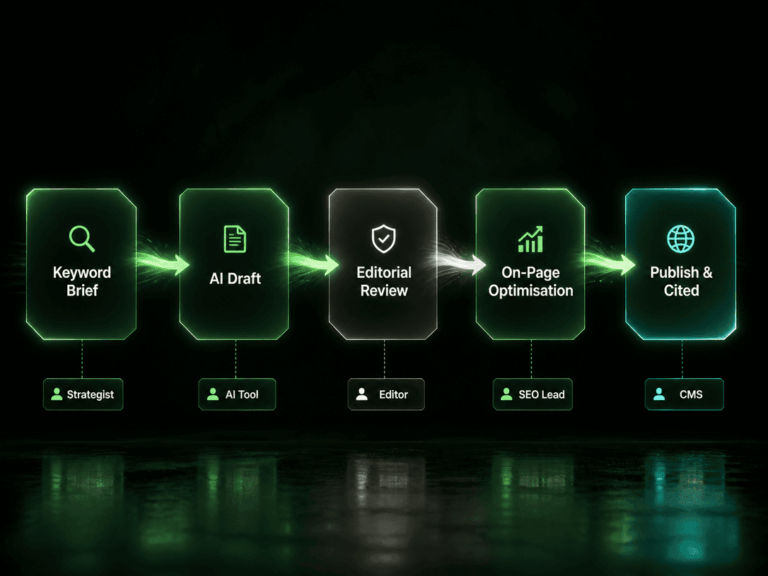
An AI content workflow for SEO is a structured, repeatable pipeline that moves a content piece from keyword brief through AI-assisted drafting, human editorial review, on-page optimisation, and publishing — with defined roles, tool assignments, and quality checkpoints at each stage. Teams that run a documented workflow consistently produce more content, at higher quality, with less bottleneck than those working ad hoc.
The goal is not to replace human judgment — it is to systematize everything that doesn’t require it. Research, first drafts, formatting, and internal linking can all be delegated to AI. Strategy, original insight, editorial review, and final approval stay with the human. That split is what makes AI content workflows both fast and trustworthy.
THE SYSTEM STACK
Three Layers. One Scalable System.
A scalable AI content workflow is built in three layers — pipeline, operating system, and prompt governance. Each layer solves a different problem. Together they eliminate the chaos that kills most content operations.
Foundation
AI Content Pipelines
The structured, repeatable process for moving content from keyword brief through AI-assisted drafting, human editorial review, and publishing. A documented pipeline eliminates chaos and makes quality consistent — whether you’re a solo operator or a team of ten.
Operating System
Content OS
The central command system for your entire content operation — keyword databases, content pipeline, publishing calendar, tool stack, and performance tracking connected in one place. Your AI workflow’s permanent home, built to hand off without losing context.
Advanced Layer
Prompt Systems & Governance
The libraries, templates, and governance frameworks that make AI outputs consistent, on-brand, and safe to publish. Without prompt systems, AI content workflows produce inconsistent results that require heavy editing and undermine the speed advantage you built the workflow to create.
FLAGSHIP INTELLIGENCE
AI Content Workflow for SEO Teams in 2026 – Build a System That Scales
The complete AEO Insider guide to building an AI content workflow from scratch — covering pipeline architecture, tool selection, role assignment, quality checkpoints, and the human-in-the-loop review process that separates publishable content from AI slop.

THE WORKFLOWS INDEX
Everything in This Category
Every article in the Workflows hub is built around implementation — not theory. Expect step-by-step systems, tool setups, SOPs, and real workflow blueprints you can adapt and deploy immediately.
-
Governance for Prompts, Style, and Knowledge Bases: The AI Content Team Playbook
How to build a prompt governance system, style guide, and knowledge base that keeps AI-generated content consistent, on-brand, and accurate across every team member and every post.
-
Human-in-the-Loop AI Content QA: The Complete Review Process for 2026
How to build a human-in-the-loop AI content QA process that catches factual errors, structural failures, and E-E-A-T gaps before publishing — without turning every post into a full rewrite.
-
How to Build a Lean AI Content System for B2B SaaS: Complete Setup Guide
How a B2B SaaS company with one content operator and a $136/month tool stack went from 11 organic sessions to 4,340 per month in 90 days — including 6 AI Overview citations. Full workflow, tool stack, and prompt template included.
-
Prompt Systems for AI SEO Briefs : Build a Library That Produces Consistent, Citable Drafts
Ad hoc prompts produce inconsistent output. A documented prompt system — with templates for every workflow stage, governed and versioned — is what makes AI content production consistent, scalable, and citation-ready from the first draft.
-
Notion-Based Content OS for AI-Native SEO – The Complete Setup Guide
A Notion Content OS turns your AI content workflow into a permanent, searchable system. Here is how to build the five core databases that run your entire SEO operation — from keyword brief to published post to performance tracking.
-
AI Content Workflow for SEO Teams in 2026 – Build a System That Scales
A repeatable AI content workflow is the difference between an SEO team that scales output without losing quality and one that produces inconsistent, unreviewed AI drafts. Here is the complete pipeline — from brief to publish — built for 2026.





Stay Ahead of AI Search.
Weekly AEO, GEO & AI SEO intelligence for marketers who want their content cited by AI. No fluff.
EXPLORE THE FULL LIBRARY
More From AEO Insider
Workflows don’t exist in isolation. The systems here connect directly to AI SEO fundamentals, GEO citation architecture, automation stacks, and monetization models.
AI SEO
Foundational frameworks for SEO in an AI-first search world
Explore AI SEO →
GEO & AEO
Frameworks for being cited inside AI-generated answers
Explore GEO & AEO →
Automation
Make, Zapier, scripts, and AI agents at scale
Explore Automation →
Monetization
Affiliate stacks, productized audits, owned-audience revenue
Explore Monetization →
Tools
Vetted comparisons and alternatives for every use case.
Explore Tools →
FREQUENTLY ASKED QUESTIONS