
AI MARKETING AUTOMATION
Stop Doing Manually
What AI Can Automate.
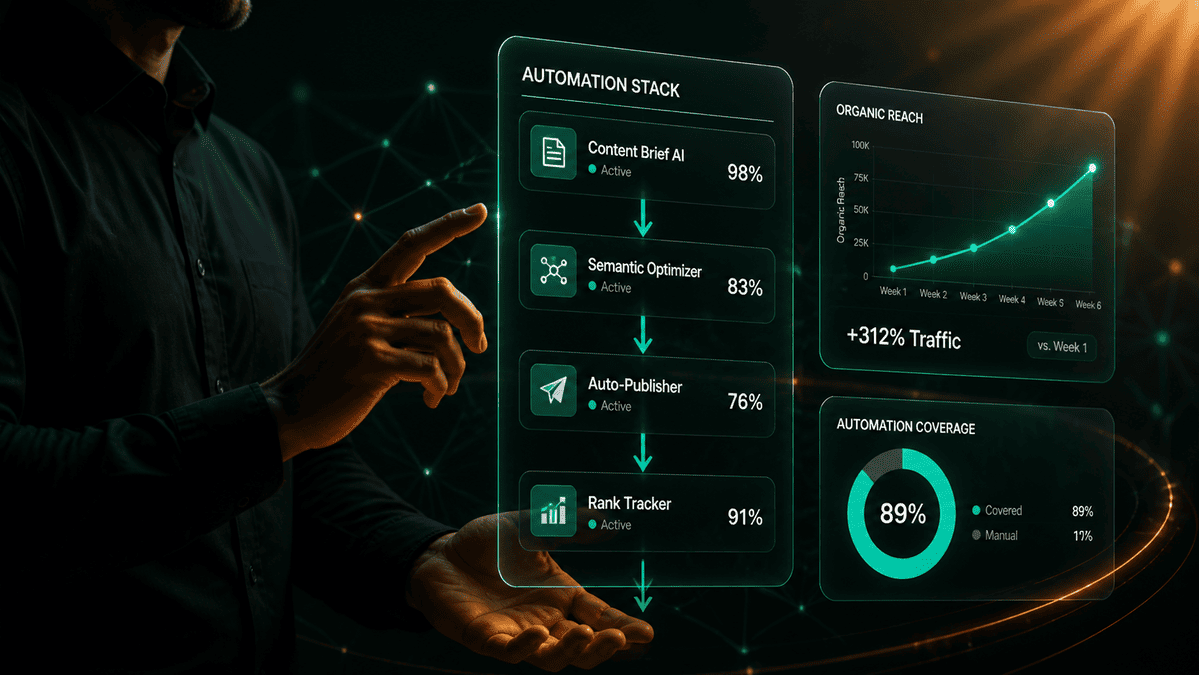
Keyword clustering, internal link audits, rank change alerts, content briefs, reporting pipelines — most of what SEO teams spend hours on each week can be handled by a well-built automation stack. This hub covers the platforms, workflows, and AI agent patterns practitioners are using right now to reclaim that time.

QUICK ANSWER
What Is AI Marketing Automation?
AI marketing automation is the use of workflow platforms (Make, Zapier, n8n), Large Language Models (LLMs), and autonomous AI agents to execute repeatable SEO and marketing tasks without manual intervention — from keyword clustering and content brief generation to reporting pipelines and distribution workflows.
The distinction that matters: automation handles execution. Strategy, quality control, and editorial judgment stay with the practitioner. The goal is not to remove humans from the loop — it is to remove humans from the parts of the loop that don’t require them.
THE STACK
Three Layers. One Integrated System.
A functional AI SEO automation stack operates across three layers — each one handling a different class of task.
Layer One
Workflow Automation
Rule-based automation using Make, Zapier, or n8n. Triggers, conditions, and actions that connect your SEO tools, CMS, and reporting systems. Best for linear, repeatable tasks where the steps are fully predictable — rank alerts, publish notifications, data aggregation.
Layer Two
AI Agents & LLM Pipelines
Goal-driven AI agents that use Large Language Models to complete multi-step research, drafting, and analysis tasks autonomously. Best for work where the exact steps aren’t predictable — competitive gap analysis, topic clustering, citation monitoring across AI platforms.
Layer Three
Reporting & Ops Automation
Automated dashboards, scheduled data pulls, and alert systems that surface rank changes, traffic anomalies, and AI citation opportunities without manual monitoring. Closes the loop between execution and measurement — so you know what’s working before your next planning cycle.
FLAGSHIP GUIDE
Marketing Automation Stack for AI-Native SEO
The definitive AEO Insider breakdown of which automation tools belong in an AI SEO stack — organized by use case, not by vendor. Covers Make vs Zapier, where n8n makes sense, which tasks to automate first, and the governance rules that keep automated outputs safe to publish.
THE AUTOMATION INDEX
Everything in This Category
Every article in the Automation hub is written for practitioners who want working systems — not conceptual overviews. Expect stack comparisons, step-by-step workflow breakdowns, and ROI-focused automation patterns.
-
SEO + AI Search + Email Growth Loop: How to Build Compounding Traffic
How to build compounding growth loops that connect SEO traffic, AI search citations, and email — so each channel strengthens the others rather than operating in isolation.
-
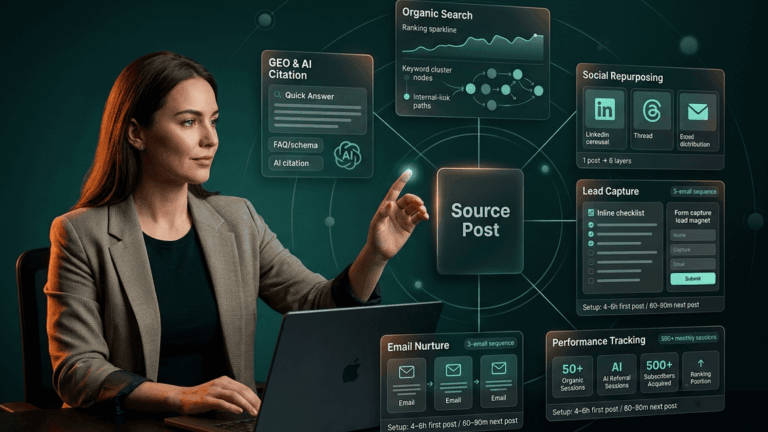
Playbook: Turn One Blog Post into a Full Automated Growth System
A step-by-step playbook for turning a single well-optimised blog post into a multi-channel, automated growth system — covering distribution, lead capture, AI citation, and email nurture in one connected workflow.
-
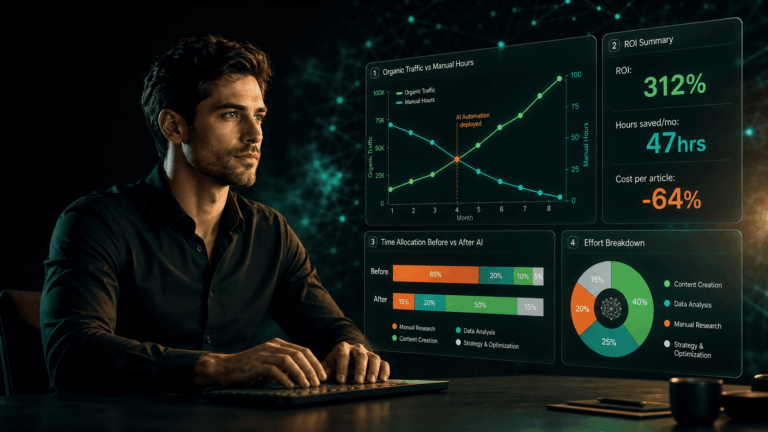
Measuring ROI of AI Automation in SEO Ops
How to measure the ROI of AI automation in SEO operations — covering the right KPIs, baseline methodology, ROI formula, and dashboard setup for teams that need to prove automation value to leadership.
-
Automating Keyword Research and Clustering: The Complete 2026 Workflow
How to automate keyword discovery, clustering, and topical mapping in 2026 — covering the best tools, AI prompts, and workflow patterns for solo operators, in-house teams, and agencies.
-
Building an AI-Assisted SEO Reporting System: Automated Data, AI Commentary, Zero Manual Work
An automated SEO reporting system — GSC and GA4 data pulled on a schedule, visualised in Looker Studio, interpreted by AI, delivered to Slack — produces better analysis than manual reporting and takes zero practitioner time to run each week.
-
AI Agents for SEO Automation: What They Are, How They Work, and Where to Start
AI agents go beyond standard automation — they receive a goal and decide their own steps. For competitive gap analysis, citation audits, and topic mapping, they reclaim hours that no rule-based workflow can replicate.



Stay Ahead of AI Search.
Weekly AEO, GEO & AI SEO intelligence for marketers who want their content cited by AI. No fluff.
EXPLORE THE FULL LIBRARY
More From AEO Insider
Automation doesn’t operate in isolation. Every system here connects to the content workflows, GEO frameworks, and monetization models that make automation worth building.
AI SEO
Foundational frameworks for SEO in an AI-first search world
Explore AI SEO →
GEO & AEO
Frameworks for being cited inside AI-generated answers
Explore GEO & AEO →
Workflows
AI content systems for teams and solo operators
Explore Workflows →
Tools
Vetted comparisons and alternatives for every use case
Explore Tools →
Monetization
Affiliate stacks, productized audits, owned-audience revenue
Explore Monetization →
FREQUENTLY ASKED QUESTIONS