
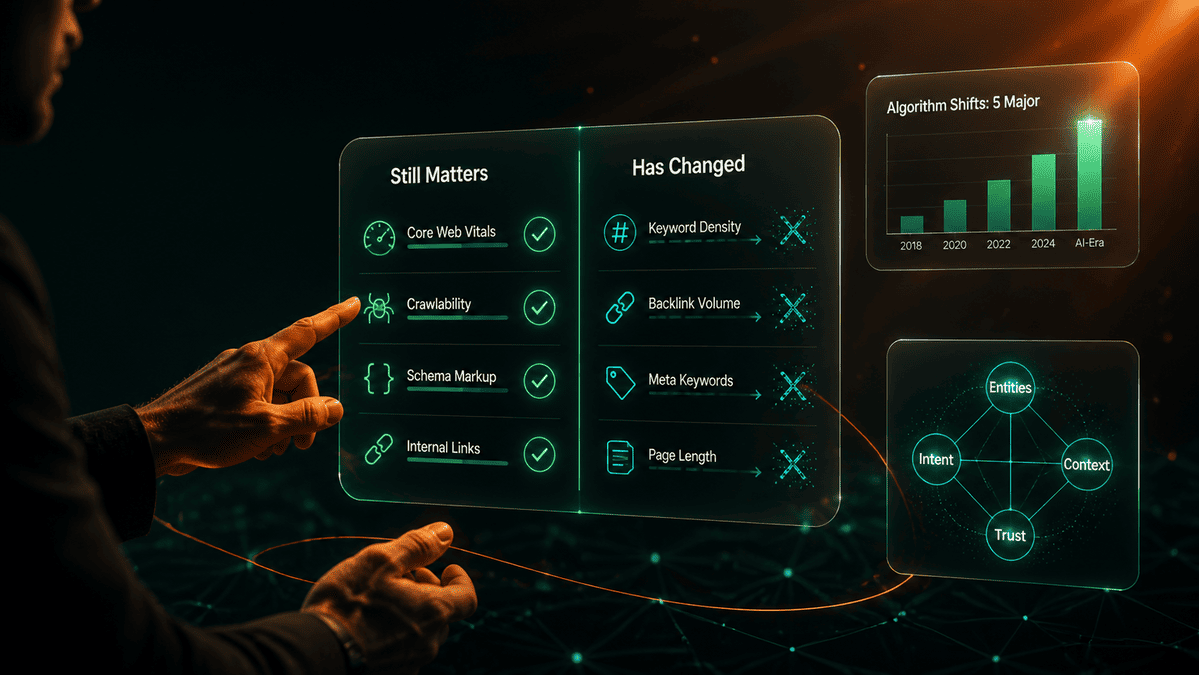
Quick answer: Technical SEO in an AI-first search environment covers the same core disciplines as traditional technical SEO — crawlability, indexability, site architecture, Core Web Vitals, and structured data — but the stakes are different. Where traditional SEO technical health determines whether you rank, AI-first technical SEO determines whether Large Language Models trust, process, and cite your content at all. A technically broken site cannot earn AI citations regardless of content quality.
A common misconception in 2026 is that the rise of generative AI search has reduced the importance of technical SEO. The argument goes: AI models read and summarise content directly, so crawl efficiency and page speed no longer matter as much. This is wrong, and the practitioners acting on it are making a significant strategic error.
Technical SEO is not in competition with Generative Engine Optimization (GEO) and Answer Engine Optimization (AEO) — it is the prerequisite layer that makes both possible. AI models source their citations from indexed, crawlable, structured content on technically sound sites. A page that is slow, poorly structured, or inconsistently crawled is a page that AI systems have less reason to trust, process, and surface. The fundamentals have not been replaced. They have been promoted to non-negotiable.
This guide covers the technical foundations that matter most in an AI-first SEO environment: what has stayed the same, what has become more important, and where the technical work directly intersects with AI citation. For context on where technical SEO fits within the broader AI search picture, see the complete overview of how AI is changing SEO in 2026.
What Is Technical SEO for AI-First Search?
Technical SEO for AI-first search is the practice of ensuring your site is structured so that both traditional search crawlers and AI content extraction systems can efficiently discover, process, and trust your content. It encompasses site architecture, crawl management, indexing signals, page performance, structured data, and publisher authority signals.
The scope has not fundamentally changed from traditional technical SEO. What has changed is the downstream consequence of getting it wrong. In a traditional SEO context, poor technical health suppresses rankings. In an AI-first context, poor technical health suppresses both rankings and AI citation — the two primary channels through which content reaches searchers in 2026. The cost of neglecting technical foundations has doubled.
The most important mental model shift is from “making pages rankable” to “making content trustworthy and extractable.” AI models do not just need to find your pages — they need to be able to decompose them into reliable, citable information. That requires clean structure, correct signals, and a site that presents itself as an authoritative, well-maintained publisher.
Which Technical SEO Signals Matter Most for AI Citation?
Not all technical SEO work is equally important for AI search visibility. The following signals have the highest direct impact on whether AI systems can process and cite your content reliably.
| Signal | Why It Matters for AI Search | Priority |
|---|---|---|
| Clean crawlability | AI systems source citations from indexed pages. Pages blocked by robots.txt, noindex tags, or crawl errors cannot be cited regardless of content quality. | Critical |
| Canonical URLs | Duplicate content without canonical signals confuses AI systems about which version of a page to attribute a citation to. Consistent canonicals establish clear authority. | Critical |
| Structured data (JSON-LD) | Article, FAQPage, and Organization schema provide machine-readable signals that AI systems use to identify content type, publisher, and answer patterns. | Critical |
| HTTPS and security | Non-HTTPS pages are treated as untrustworthy by both browsers and AI systems. All content must be served over HTTPS. | Critical |
| Page speed / Core Web Vitals | Slow pages are crawled less frequently and indexed less reliably. LCP above 2.5 seconds is a crawl efficiency problem, not just a UX problem. | High |
| Mobile responsiveness | Google’s mobile-first indexing means the mobile version of your page is the indexed version. AI systems work from the indexed version. | High |
| Internal linking architecture | Topical cluster architecture — hub pages linking to cluster articles and back — signals topical authority that influences how AI models weight your content as a source. | High |
| Site depth and URL structure | Content buried three or more clicks from the homepage is crawled less consistently. Flat, logical URL structures improve crawl coverage. | Medium |
| XML sitemap accuracy | An accurate, updated sitemap improves crawl efficiency and reduces the lag between publishing and indexing — important when AI citation windows can be narrow. | Medium |
The critical-priority signals above form the non-negotiable foundation. If any one of them is broken at scale — widespread crawl errors, missing canonicals, no HTTPS — it undermines the entire AI SEO strategy regardless of content quality or schema implementation.
The most common critical failure I encounter across new client account audits is a noindex tag left active from the development phase — a WordPress developer sets the site to noindex during build to prevent Google from crawling an incomplete site, and nobody removes it after launch. The site appears to function normally, pages rank for branded queries, traffic arrives via direct and social channels, and nobody notices. Meanwhile the entire site is invisible to AI Overview sourcing. I have found and fixed this across multiple accounts; in each case the client had been publishing content for months with zero indexing coverage. It takes thirty seconds to check in Rank Math or Yoast. It should be the first line of any technical audit.
How Does Schema Markup Affect AI Search Visibility?
Schema markup — specifically JSON-LD structured data — is the single highest-leverage technical implementation for AI citation. It is also the most commonly incomplete. Most sites implement basic schema but miss the entity-level declarations that AI systems use to identify publisher authority and content relationships.
The four schema types that matter most for AI-first SEO are:
- Article schema with
aboutandmentionsfields. Standard Article schema tells AI systems the content type, author, and publisher. Theaboutfield — which explicitly lists the key entities a page is about — is the critical addition most implementations miss. Addingaboutandmentionsarrays with named entity objects dramatically improves LLM understanding of what the page covers and increases citation probability for those entities. - FAQPage schema. FAQ sections with FAQPage schema are one of the most consistently cited content structures across AI platforms. The explicit question-answer pairing in machine-readable format makes it trivially easy for AI systems to extract and attribute a direct answer. Every article with a FAQ section should have FAQPage JSON-LD applied. Implement via Rank Math Pro’s FAQ schema block or by manually adding the JSON-LD to the page’s HTML block.
- Organization schema on the homepage and About page. Organization schema — including
name,url,logo,description,sameAs(social profiles), andknowsAbout(topic entities) — establishes your site as an identified, trustworthy publisher in the knowledge graph. AI systems use publisher identity signals when weighting citation sources. A site without Organisation schema is an anonymous publisher; a site with complete Organisation schema is a named authority in its declared topics. - BreadcrumbList schema. Breadcrumb schema communicates site architecture to both crawlers and AI systems. It reinforces the topical cluster structure — confirming that a given article belongs to a defined pillar — and helps AI models navigate your content hierarchy when assembling multi-source answers.
A unified @graph approach — combining all four schema types into a single JSON-LD block per page — is cleaner and more reliable than separate script tags. Google and most AI processing systems handle a well-structured graph more predictably than multiple independent schema blocks competing for the same page context.
In practice, when client accounts arrive with an existing SEO plugin setup — whether Yoast or Rank Math — the basic optimised configuration generates Article schema without about or mentions fields. These are not defaults in either plugin, and every account I have audited has had this gap. Adding custom schema with populated entity fields produces a visible improvement in AI Overview citation frequency and in the AI visibility statistics that monitoring tools report — not a theoretical uplift. Implementation requires either custom JSON-LD injected via a code snippet or Rank Math’s Custom Schema builder. It adds roughly thirty minutes per article template to configure correctly and has been one of the highest-leverage technical additions across accounts.
What Site Architecture Decisions Have the Biggest Impact on AI Crawling?
Site architecture decisions made during the initial build compound over time. Good architecture makes AI citations easier to earn and harder to lose. Poor architecture creates persistent crawl inefficiencies and topical authority diffusion that no amount of content quality can fully compensate for.
The three architecture decisions with the highest AI SEO impact are:
- Pillar-cluster URL structure. Organising content into defined topic hubs (
/ai-seo/,/geo-aeo/,/workflows/) with cluster articles nested beneath them creates a crawlable, machine-interpretable topical hierarchy. AI systems use URL structure as a weak but real signal of content taxonomy. A cluster article at/ai-seo/technical-seo-for-ai-search/is contextually clearer to a crawler and an LLM than an article at/blog/technical-seo/on a site without defined pillar structure. - Consistent, bidirectional internal linking. Every cluster article should link to its pillar hub. Every pillar hub should link to and from its cluster articles. This bidirectional linking structure reinforces topical authority signals in both directions — the hub accumulates authority from its clusters, and clusters inherit contextual relevance from the hub. Inconsistent internal linking — where some cluster articles are not linked from the hub — creates authority gaps that AI systems can and do penalise in citation weighting.
- Dedicated hub pages with entity-rich content. AI models are significantly more likely to cite from a site that has a dedicated, well-structured page for a given entity or topic — compared to a site where the same topic is covered only in individual blog posts without a central reference page. Building pillar hub pages (like the topic hubs in this site’s architecture) is a direct AI citation investment, not just a UX improvement.
One architecture mistake to avoid: creating category archive pages that compete with hub pages for the same topical keywords. If your CMS generates a /category/ai-seo/ archive that sits alongside a dedicated /ai-seo/ hub page, you have two pages competing for the same entity signals. Either consolidate them or ensure the category archive is noindexed so the hub page receives all topical authority.
How Do Core Web Vitals Factor Into AI-First SEO in 2026?
Core Web Vitals — Largest Contentful Paint (LCP), Interaction to Next Paint (INP), and Cumulative Layout Shift (CLS) — remain a Google ranking signal in 2026. Their relationship to AI citation is indirect but real: pages that perform poorly on Core Web Vitals are crawled less frequently and indexed less reliably, which reduces the probability of appearing in AI-generated answers.
The practical targets for an AI SEO-focused site:
| Metric | Target | Common Failure Source on Content Sites |
|---|---|---|
| LCP (Largest Contentful Paint) | Under 2.5 seconds | Unoptimised hero images, uncompressed featured images, render-blocking third-party scripts |
| INP (Interaction to Next Paint) | Under 200ms | Heavy JavaScript plugins, undeferred analytics scripts, bloated page builders |
| CLS (Cumulative Layout Shift) | Under 0.1 | Images without defined dimensions, late-loading ad or newsletter embeds, web font swap |
For a Kadence Block Theme site, the three highest-leverage Core Web Vitals improvements are: serving images in WebP format with explicit width and height attributes, deferring non-critical JavaScript (analytics, chat widgets, social embeds) to load after the main content, and using Cloudflare or a hosting-level CDN to reduce server response times below 200ms. None of these require developer resources — they are configuration decisions in Kadence, Cloudflare, and your hosting panel.
What Are E-E-A-T Signals and How Do They Apply to AI-Native Search?
E-E-A-T — Experience, Expertise, Authoritativeness, and Trustworthiness — is Google’s framework for evaluating content quality, but it operates through technical and structural signals as much as through content quality alone. For AI citation, E-E-A-T signals function as publisher credibility markers that influence how heavily an LLM weights a source when assembling a multi-source answer.
The technical implementations that strengthen E-E-A-T signals for AI search:
- Author schema and author pages. Every article should have an identified author with a dedicated author page that includes a bio, credentials, and links to social or professional profiles. Author schema on each article, referencing the author’s
Personentity, signals to both Google and AI systems that a named, identifiable person with demonstrated expertise is responsible for the content. - Publisher Organisation schema with
sameAslinks. Linking your site’s Organization schema to verified third-party profiles (LinkedIn, Twitter/X, Crunchbase, industry directories) connects your publisher identity to the broader knowledge graph. AI systems use these cross-references to assess publisher legitimacy and topical authority scope. - External citations in content. Every article should include 2–3 links to authoritative external sources — official documentation, peer-reviewed research, published industry reports. These outbound links are a trust signal to AI systems: they indicate a publisher that situates its claims within a broader information ecosystem rather than treating itself as the sole authority.
- Consistent, accurate About and Contact pages. A site with complete, accurate About, Contact, and Privacy pages presents as a legitimate, maintained publisher. Their absence is a negative trust signal that AI systems and Google’s quality reviewers both register.
- Original data and primary source citations. Content that references original research, proprietary data, or named case studies — with explicit attribution and where possible links to primary sources — carries significantly more citation weight than content that synthesises what other sites have already published. This is the content-level E-E-A-T signal that complements the technical implementation.
E-E-A-T is not a single technical fix — it is a cumulative signal built across many pages over time. The technical implementations above can be audited and implemented in a focused sprint. The content-level signals — original data, practitioner experience, specific case studies — compound with every article published.
How Do You Audit Your Site for AI-First Technical SEO Readiness?
A technical SEO audit for AI-first search covers five areas. Run this audit before investing heavily in GEO content optimisation — technical gaps at the foundation level will suppress the return on any content work done above it.
- Crawl and index audit. Run a full crawl using Screaming Frog or Ahrefs Site Audit. Flag: pages returning 4xx or 5xx errors, pages blocked by robots.txt that should be indexed, pages with noindex tags that should not have them, redirect chains longer than two hops, and duplicate pages without canonical tags. Every flagged item is a potential AI citation dead end.
- Schema audit. Open Google’s Rich Results Test for your five most important pages. Confirm Article, FAQPage, BreadcrumbList, and Organization schema are present and validating without errors. Check that
aboutandmentionsfields are populated in Article schema. Check that FAQPage schema mirrors the visible FAQ content on the page. - Core Web Vitals audit. Run Google PageSpeed Insights on your homepage, a pillar hub page, and your three highest-traffic articles. Address any LCP failures above 2.5 seconds and CLS above 0.1 as priority fixes — these are the two metrics with the highest crawl frequency correlation.
- Internal linking audit. Export your internal link map from Screaming Frog. Identify cluster articles that are not linked from their pillar hub. Identify orphan pages — articles with fewer than two internal links pointing to them. Both represent topical authority gaps that depress both traditional rankings and AI citation probability.
- E-E-A-T signal audit. Check: author pages exist for all named contributors, Organization schema is complete on the homepage, About and Contact pages are present and accurate, all articles include at least two external citations to primary sources, and no articles are listed without an identified author.
A full technical audit of a content site typically takes 4–8 hours with the right tools. Prioritise the crawl and schema audits first — they have the highest direct impact on AI citation readiness. Core Web Vitals and E-E-A-T improvements compound over time but rarely require urgent intervention unless there are severe performance failures.
For reference: aeoinsider.com currently scores 89 on Performance, 96 on Accessibility, and 100 on both Best Practices and SEO in Lighthouse — on a Kadence Block Theme with no performance engineering beyond standard image optimisation and Cloudflare. The 89 on Performance is the remaining gap, driven by render-blocking resources and third-party script load order rather than anything structural. The 100 scores on SEO and Best Practices confirm clean canonical signals, correct schema implementation, and no critical technical errors. For most content sites, reaching this baseline is achievable within a standard audit sprint, without developer resources, using the configuration decisions in Kadence, Rank Math, and your hosting panel.
Frequently Asked Questions
The Bottom Line
Technical SEO is the foundation that every other AI search strategy is built on. Before an AI model can cite your content, your site needs to be crawlable, indexed, fast enough for reliable crawl frequency, and structured with schema that makes entity relationships machine-readable. These are not new disciplines — they are existing technical SEO principles with higher stakes in an AI-first search environment.
The practitioners who will earn the most AI citations in 2026 are not those writing the most content — they are those who have built technically sound sites with clean architecture, complete schema, strong E-E-A-T signals, and consistent internal linking. Content quality gets you into the citation conversation. Technical health determines whether you stay in it.
Next: see how the full SEO vs AEO vs GEO framework builds on this technical foundation — or go deeper on content structure with the AI content workflow guide for SEO teams.

Written by
AEO Insider Editorial Team
We help modern marketers and operators get their content cited by AI, discovered in search, and wired into scalable growth systems. Our collective focus is entirely on the cutting edge of AEO, GEO, and AI-native SEO.
ABOUT AEO Insider →




3 Comments