
Quick answer: Answer Engine Optimization (AEO) is the practice of structuring content to be surfaced and cited inside answer engines — platforms and features that return a direct answer to a user query rather than a list of links. The primary AEO surfaces in 2026 are Google AI Overviews, featured snippets, People Also Ask boxes, and voice search results. AEO requires direct answer blocks, question-based structure, schema markup, and entity clarity.
The majority of SEO professionals have been optimising for ranked positions since the discipline began. AEO asks you to optimise for something different: not the position your page occupies in a list of results, but whether your content is selected as the answer itself.
That distinction matters because a growing share of Google searches now end with the user reading an AI-generated summary or a featured snippet at the top of the page — without clicking any result at all. If your content is cited in that summary, you gain visibility and brand recognition. If it is not, you become effectively invisible for that query regardless of your ranking.
This guide explains exactly what AEO is, which surfaces it targets, how Google decides what to cite, and the six content techniques that consistently drive citation. For the broader context on why this shift is happening, read How AI Is Changing SEO in 2026. For the relationship between AEO and its companion discipline, see What Is GEO?
What Are Answer Engines?
An answer engine is a system designed to return a direct, synthesised answer to a user query — as opposed to a search engine, which returns a ranked list of potentially relevant pages and leaves the user to find the answer themselves.
Answer engines are not new. Google introduced featured snippets in 2014 — pulling a specific passage from an indexed page and displaying it above the organic results as a direct answer. Voice assistants like Google Assistant and Siri extended this model to spoken queries, reading a single extracted answer aloud. What is new in 2026 is the scale and sophistication of AI-generated answer surfaces.
Google AI Overviews — the AI-generated summary now appearing at the top of results for a substantial share of informational queries — represents a qualitative leap beyond the featured snippet. Where a featured snippet extracted a single passage verbatim, AI Overviews synthesise information from multiple sources into an original, multi-sentence response that cites each contributing source. The mechanism is different, the scale is larger, and the stakes for content publishers are higher.
Which Surfaces Does AEO Target?
AEO in 2026 covers four primary surfaces — each with its own extraction mechanism and content format preferences.
- Google AI Overviews. The AI-generated summary panel that appears at the top of Google Search results for informational queries. AI Overviews pull from multiple cited sources and generate an original response. Content that is well-structured, directly answers the query, and contains clear entity definitions has the highest probability of being selected as a source. Cited sources receive a visible attribution link inside the Overview panel.
- Featured Snippets (Position Zero). A single extracted passage — paragraph, numbered list, or table — shown above the first organic result. Featured snippets are pulled verbatim or near-verbatim from indexed content, making direct answer blocks and well-formatted lists the most reliable optimisation targets. Featured snippets and AI Overviews can coexist on the same results page for the same query.
- People Also Ask (PAA) Boxes. An expandable Q&A panel showing related questions and short extracted answers. PAA boxes are dynamically generated and often pull from the same pages that rank well for the primary query. Structured FAQ sections are the most reliable content format for winning PAA visibility.
- Voice Search Results. When a user asks Google Assistant, Siri, or a smart speaker a question, the system reads a single answer aloud — almost always drawn from a featured snippet or AI Overview source. Voice search queries tend to be conversational and question-based, making question-phrased content structure directly aligned with voice extraction patterns.
Of the four AEO surfaces, featured snippets respond fastest to structural changes — Google’s extraction logic is relatively predictable and the mechanism is direct. Voice search is the hardest surface to move deliberately. Voice results are almost entirely pulled from existing featured snippet winners, making voice optimisation a downstream outcome of featured snippet success rather than an independent lever worth targeting separately.
How Does AEO Differ from Traditional SEO?
Traditional SEO and AEO share the same foundation — well-indexed, authoritative content on relevant topics — but diverge in their optimisation targets and content requirements.
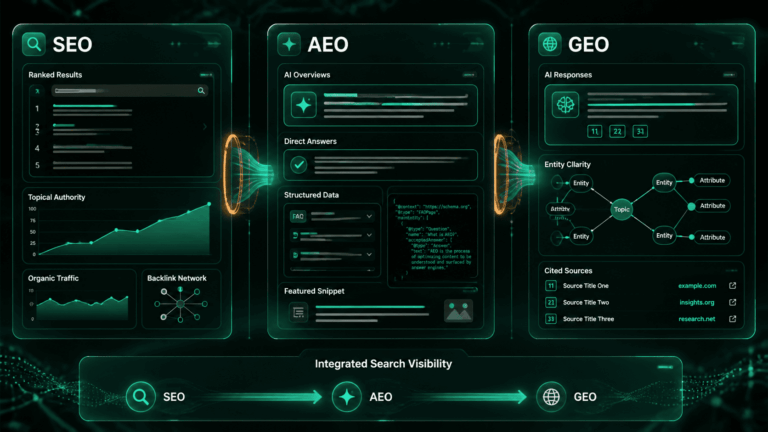
Traditional SEO optimises for rank position. The primary signals are topical authority, backlink profile, technical site health, and on-page content quality. Success is measured in ranking position and organic click volume.
AEO optimises for citation selection. The primary signals are content structure, entity clarity, schema markup, and answer proximity. Success is measured in featured snippet ownership, AI Overview citation frequency, and PAA presence — not necessarily in position or click volume.
The important nuance: a page does not need to rank at position one to be cited in an AI Overview or featured snippet. Google’s citation selection for AI Overviews is influenced by structural quality independently of rank. This means AEO creates citation opportunities for well-structured content that is not the top-ranked result — a meaningful opportunity for newer sites and practitioners who cannot yet compete on pure link authority.
This holds in practice. Aerotimelapse.com — a specialist site covering aerial photography and timelapse production — has been built consistently with AEO and GEO structural principles applied from the ground up: direct answer blocks, question-based subheadings, dedicated FAQ sections, and explicit schema markup. The site does not rank at position one for most of its target keywords. It is nonetheless regularly cited by Perplexity, ChatGPT, and other AI models across multiple topics in its niche. Structural correctness, applied consistently across a content cluster, compensates for domain authority in AI citation in a way it simply does not in traditional organic rankings.
How Does AEO Differ from GEO?
AEO and GEO are closely related and often confused. The distinction comes down to mechanism and surface.
AEO targets retrieval-based answer systems — primarily Google’s infrastructure, which indexes your content, identifies structured answer passages, and extracts them for featured snippets and AI Overviews. The process is essentially retrieval: find the best-structured answer in the index and surface it.
GEO targets generation-based AI systems — ChatGPT, Perplexity, Gemini, and Copilot — which read web content, synthesise it, and generate an original response that cites its sources. The process is generative: understand multiple sources and produce something new from them.
In practice, the content improvements that serve AEO — direct answer blocks, question subheadings, FAQ sections, entity definitions — also improve GEO performance. They use the same content toolkit but serve different surfaces. A complete treatment of how they interact is in the SEO vs AEO vs GEO breakdown.
How Does Google Decide What to Show in AI Overviews and Featured Snippets?
Google has not published a complete specification for AI Overview source selection, but its behaviour is consistent enough to identify the dominant factors.
Query match specificity. Google’s systems prefer content that answers the precise query asked — not content that covers the broader topic.
Answer proximity. The direct answer to the query should appear near the top of the relevant section — ideally in the first one to three sentences after the heading. Burying the answer in the middle of a long paragraph reduces extraction probability significantly.
Content trustworthiness signals. Pages from sites with established topical authority, consistent E-E-A-T signals, and external citation profiles are weighted more heavily as AI Overview sources.
Structured data presence. Pages with correctly implemented FAQPage, Article, and HowTo schema markup signal their content structure explicitly to Google’s systems. Schema does not guarantee citation, but its absence is a missed signal.
Freshness and accuracy. For time-sensitive queries, Google’s AI Overview systems weight recently updated, accurate content. Stale information is less likely to be cited for queries where recency matters.
6 AEO Content Techniques That Drive Citation
These six techniques are the practical implementation of AEO principles. Apply them to new content from day one and retrofit them to your highest-traffic existing articles in priority order.
- Lead every article with a direct answer block. The first paragraph after your title should be a 40–60 word plain-language answer to the primary question your article addresses. Write it as a complete, self-contained answer with no preamble. This block is the single highest-yield AEO investment per unit of writing time.
- Convert subheadings to complete questions. Every H2 and H3 in your article should be phrased as a complete question that a user or AI assistant might ask. Question headings map your content structure directly to the query decomposition logic that AI Overview systems use to match content sections to specific sub-questions.
- Use numbered and bulleted lists for step-based content. Google’s featured snippet algorithm consistently prefers structured lists over prose for how-to and step-based queries. Keep list items parallel in structure and lead each item with the most important word.
- Build a dedicated FAQ section into every article. A FAQ section with five to six specific, self-contained Q&A pairs is one of the most reliably cited content formats for both featured snippets and AI Overviews. Each answer should be under 80 words and complete without requiring the reader to have read the rest of the article. Apply FAQPage schema markup to every FAQ section.
- Implement schema markup consistently. At minimum, apply Article schema to every post and FAQPage schema to every FAQ section. Schema markup does not directly improve rankings but it explicitly signals content structure to Google’s systems. In practice, the lag between implementing FAQ sections and FAQPage schema and observing their effect on featured snippet wins or AI Overview appearances typically falls between three and five weeks — consistent with standard Google re-crawl cycles for updated content. Set a five-week review checkpoint after any schema implementation before drawing conclusions about its impact.
- Define entities explicitly at first mention. Every named concept, tool, organisation, or methodology should be defined clearly the first time it appears. Explicit definitions improve entity recognition in both Google’s Knowledge Graph integration and in the LLM-based systems that power AI Overviews — making your content more reliably attributed when cited.
How Do You Measure AEO Performance?
AEO measurement has become more tractable in 2025–2026 as platform tools have added AI visibility tracking. Four measurement approaches are available now.
Google Search Console AI Overview data. Google Search Console is beginning to surface impression and click data for AI Overview appearances for some accounts. Check your Performance report and filter by “AI Overviews” where available.
Featured snippet tracking. Tools including Semrush, Ahrefs, and SE Ranking track featured snippet ownership for monitored keywords. Run a featured snippet audit across your target keyword set to identify which queries you currently own, which you are positioned for but not winning, and which represent new AEO opportunities.
AI Overview visibility tracking. Semrush’s AI Overview tracker and SE Ranking’s AI Overview monitoring feature track whether your pages appear as cited sources inside Google AI Overviews for tracked keywords.
PAA monitoring. Track which People Also Ask questions are associated with your primary keywords and whether your content is being pulled as the answer. Expanding your PAA coverage is a tractable, measurable AEO objective that can be driven specifically by adding FAQ sections to existing content.
What AEO Means for Agencies, In-House Teams, and Solo Creators
For agencies: AEO is an audit and implementation service waiting to be productised. Most clients have existing content that ranks reasonably well for informational queries but has never been retrofitted for AI Overview citation — no direct answer blocks, no FAQ sections, no schema markup. An “AEO Content Retrofit” service — auditing the top 20 informational pages on a site and restructuring them for answer engine citation — is a well-defined, deliverable scope that justifies a clear fixed price. The most consistently recurring finding in AEO audits is orphan pages with no internal linking. Content that earns no internal links is effectively invisible to both crawlers and AI systems attempting to map topical relationships across a site. Before addressing any content-level AEO optimisation, an internal link audit identifying and connecting orphan pages to their relevant pillar hubs is almost always the first structural fix with the clearest downstream impact.
For in-house teams: AEO gives you a concrete action plan for informational content that is losing visibility to AI Overviews. Rather than responding to traffic declines defensively, you can run a proactive AEO audit, identify the highest-traffic pages not currently cited in AI Overviews, and build a retrofit backlog that your content team can work through systematically.
For solo creators: AEO is a leverage play. Every article you publish with a direct answer block, question-based subheadings, and a FAQ section has a materially higher probability of appearing in an AI Overview than a competitor’s article without those elements — regardless of relative domain authority. This is one of the few areas in SEO where structure consistently competes with scale.
Frequently Asked Questions
The Bottom Line
Answer Engine Optimization is not a future-looking discipline. It is the set of content decisions that determines whether your work appears as a cited, named source in the AI Overviews and featured snippets that users are reading right now — before they ever scroll to an organic result.
The six AEO techniques in this guide require no new tools, no developer resources, and no fundamental change to your content strategy. They are structural decisions about how you open each article, how you label each section, and how you close each piece. Applied consistently, they compound into a content library that AI systems recognise as a reliable source — and cite accordingly.
Next: explore the full GEO & AEO Playbooks for implementation templates and content architecture patterns — or audit your current highest-traffic articles against the AI Search Readiness Checklist to identify which pages to retrofit first.

Written by
AEO Insider Editorial Team
We help modern marketers and operators get their content cited by AI, discovered in search, and wired into scalable growth systems. Our collective focus is entirely on the cutting edge of AEO, GEO, and AI-native SEO.
ABOUT AEO Insider →
2 Comments