
Quick answer: The best AI SEO tools for 2026 depend on your use-case. For keyword research and clustering: Ahrefs or Semrush. For content drafting: Claude or ChatGPT. For on-page optimisation: Surfer SEO or Clearscope. For GEO and AI Overview visibility tracking: Semrush AI Overviews or SE Ranking. For reporting: SE Ranking or Looker Studio with a custom AI traffic dashboard. No single tool covers every stage — the teams winning in 2026 run a connected stack of four to six tools, each assigned to a specific workflow stage.
Affiliate disclosure: Some links in this article are affiliate links. If you purchase through them, AEO Insider earns a commission at no extra cost to you. We only recommend tools we’ve evaluated against the criteria in this guide.
The AI SEO tool market in 2026 is noisy. Every major SEO platform has added “AI features.” Dozens of new tools have launched claiming to solve GEO, AEO, AI Overview optimisation, and LLM citation in a single dashboard. Most of them do one thing adequately and several things poorly. The practitioners actually gaining ground are not chasing the newest AI SEO tool — they are running a small, deliberate stack where each tool has a defined role and nothing overlaps unnecessarily.
This guide cuts through that noise. Every tool listed here has been selected against four criteria: it solves a specific, documented use-case in the AI-native SEO workflow; it integrates with the five-stage content pipeline without adding friction; it has a credible track record in 2025–2026 conditions; and it offers a clear ROI relative to its cost at the team sizes most AEO Insider readers are operating at.
The guide is organised by workflow stage — keyword research, content drafting, on-page optimisation, GEO visibility, and reporting — and closes with three opinionated stack recommendations by team type. For context on how these tools fit into a complete workflow, see the AI Content Workflow for SEO Teams and the Notion Content OS where these tools are assigned to specific pipeline stages.
How Were These AI SEO Tools Selected for 2026?
Every tool in this guide was evaluated against five criteria specific to AI-native SEO in 2026 — not against general feature sets or vendor marketing claims.
- GEO and AEO relevance. Does the tool help you understand, optimise for, or track performance in AI-generated answers — including Google AI Overviews, Perplexity citations, and ChatGPT responses? Tools that only track traditional rankings without any AI visibility layer are listed only when no credible AI-capable alternative exists for that use-case.
- Workflow integration. Does the tool fit into the five-stage content pipeline — brief, research, draft, review, publish — without requiring a separate standalone process? Tools that operate as isolated islands (no export, no API, no workflow connection) score lower regardless of feature depth.
- Output quality for structured content. For AI drafting and optimisation tools specifically: does the tool reliably produce content that passes the structural requirements for AI citation (answer blocks, question H2s, entity completeness, FAQ sections)? Tools that generate high-volume but structurally thin content are excluded from drafting recommendations.
- Value at practical team sizes. Pricing is assessed relative to the output a two-to-five person content team or solo operator can reasonably extract. Enterprise-only tools with minimum contracts above $1,000/month are excluded unless they offer a meaningful SMB tier.
- Stability and track record. Tools launched after January 2025 with no documented track record of consistent output quality are excluded. The AI tool space has a high failure rate — this guide prioritises tools with at least 12 months of verified production use.
What Are the Best AI SEO Tools for Keyword Research and Topic Clustering?
Keyword research in 2026 is not just about search volume and difficulty — it requires identifying which queries have active AI Overview coverage, which have conversational AI query demand (people asking the same question in ChatGPT and Perplexity), and how to cluster topics into coherent pillar structures that build topical authority. The tools below handle these requirements at different price points and depth levels.
| Tool | Best For | AI SEO Capability | Starting Price | Verdict |
|---|---|---|---|---|
| Ahrefs | Deep keyword research, competitor gap analysis, backlink data | AI Overview keyword filtering in Keyword Explorer; topical clustering via Content Gap | $129/month (Lite) | Best-in-class for keyword data depth and competitor research. The go-to for agencies managing multiple clients and in-house teams with complex cluster architectures. |
| Semrush | All-in-one keyword, on-page, and AI Overview tracking | AI Overview presence data per keyword; AI-generated content briefs; Copilot assistant | $139.95/month (Pro) | The strongest single platform for combining keyword research with AI Overview visibility in one dashboard. Preferred for teams that want fewer tool switches. |
| SE Ranking | Keyword tracking, local SEO, AI Overview monitoring at lower cost | AI Overview tracking per keyword; SERP feature monitoring including People Also Ask | $65/month (Essential) | Best value for small teams and solo operators. Covers AI Overview tracking at a price point that Ahrefs and Semrush cannot match. Feature depth is lower but sufficient for most use-cases below agency scale. |
| Surfer SEO | AI-assisted topic clustering and content planning | Topical Map feature generates AI-suggested cluster structures from a seed keyword | $99/month (Essential) | The Topical Map feature is the standout for cluster architecture planning. Less useful as a primary keyword research tool; best used alongside Ahrefs or Semrush for volume and difficulty data. |
Recommended pick by team type: Solo operators → SE Ranking. In-house teams → Semrush (for the AI Overview layer). Agencies → Ahrefs for research depth, Semrush for AI Overview reporting to clients.
What Are the Best AI Tools for Content Research and Drafting?
Content drafting tools split into two categories in 2026: large language model interfaces (Claude, ChatGPT) used with detailed prompts and briefs, and purpose-built AI writing tools with SEO-specific features (Jasper, Writesonic) that add structure on top of an LLM base. The best drafting setups combine both — an LLM for primary draft generation against a detailed brief, and a research tool for sourced citations.
| Tool | Best For | Structural Content Capability | Starting Price | Verdict |
|---|---|---|---|---|
| Claude (Anthropic) | Long-form draft generation against structured briefs | Follows detailed structural instructions reliably; produces answer blocks, question H2s, FAQ sections, and entity-rich content with consistent fidelity to brief requirements | $20/month (Pro) | Best general-purpose LLM for SEO content drafting in 2026. Superior instruction-following on complex structural briefs compared to GPT-4o. Recommended as the primary drafting tool for the AI content workflow. |
| ChatGPT (OpenAI) | Research-integrated drafting with Browse; multi-step workflow tasks | Strong structural output; Browse mode allows real-time source retrieval during drafting; GPT-4o handles long-form content well | $20/month (Plus) | Best when real-time source retrieval during drafting is required. The Browse capability makes it the preferred choice for research-heavy posts that need current data verified during generation. |
| Perplexity Pro | Sourced research with primary citations; competitive intelligence | Generates cited research summaries with linked primary sources; not a drafting tool but the best research input layer before drafting | $20/month (Pro) | Not a replacement for a drafting LLM — it is the research stage tool. Use Perplexity Pro to generate a sourced research document with primary links, then feed that into Claude or ChatGPT for the draft. Essential in the workflow for posts requiring verified external citations. |
| Jasper AI | Brand-voice-consistent content at team scale | SEO mode with keyword integration; brand voice training; multi-user workflow management | $49/month (Creator) | Best for teams needing brand voice consistency across multiple writers using AI. The Brand Voice feature trains on existing content to maintain tone at scale. Less flexible than Claude for complex structural briefs; stronger for teams producing high volumes of shorter-format content. |
What Are the Best AI Tools for On-Page Optimisation and Content Scoring?
On-page optimisation tools in 2026 serve a specific role in the workflow: they validate that an AI-generated and human-reviewed draft meets entity coverage, keyword density, and structural requirements before publishing. They are QA tools, not primary drafting tools — used at Stage 4 of the content pipeline, not Stage 3.
| Tool | Best For | AI SEO Capability | Starting Price | Verdict |
|---|---|---|---|---|
| Surfer SEO | Real-time content scoring; entity coverage; NLP-based optimisation | Content Score grades entity and keyword coverage; AI-generated outlines; SERP Analyser shows AI Overview presence for target keywords | $99/month (Essential) | The standard for on-page content scoring in AI-native SEO workflows. The Content Score provides a reliable proxy for entity completeness. Integrate at Stage 4 of the workflow as the pre-publish QA signal. |
| Clearscope | Entity and term coverage scoring for longer-form content | Term frequency and relevance grading based on top-ranking content; Google Docs integration for in-editor scoring | $199/month (Essentials) | More accurate entity scoring than Surfer SEO on complex or technical topics, at a higher price point. The Google Docs integration makes it the preferred choice for teams whose editorial review happens in Docs rather than directly in WordPress. |
| Frase | Brief generation, SERP research, and content scoring in one tool | SERP-based brief generation with People Also Ask integration; AI answer drafting directly in the editor | $45/month (Solo) | Best value for solo operators who want brief generation, research, and content scoring in a single tool. Feature depth is below Surfer SEO and Clearscope individually, but the combined brief-to-score workflow reduces tool switching. |
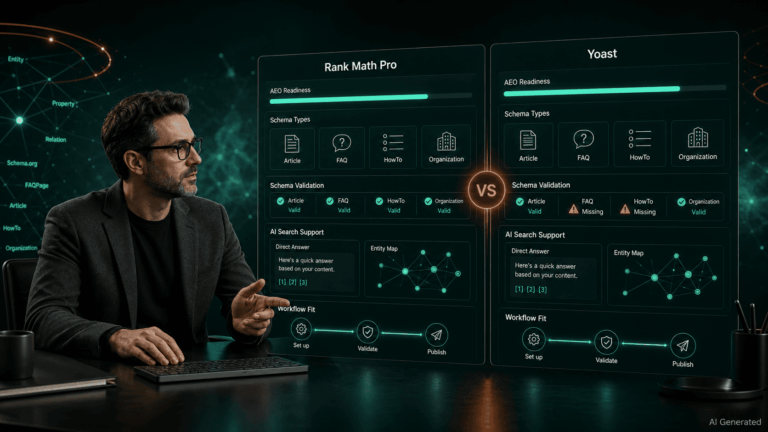
| Rank Math Pro | WordPress on-page SEO, meta fields, and schema management | FAQPage schema, Article schema, and AI Overview-optimised meta templates; SEO score with content analysis | $69/year | Non-negotiable for WordPress-based content operations. Handles FAQPage schema, meta title and description, Article schema, and on-page SEO scoring directly in the WordPress editor. The lowest-cost highest-impact tool in the entire stack. |
In practice, a Claude-drafted post typically lands at a Surfer Content Score of 52–62 before any editing — Claude writes for argument flow and AI extractability, not for Surfer’s NLP term density benchmarks. After one targeted optimisation pass, the score usually reaches 74–80, which is solidly publishable. The honest caveat: hitting the Surfer target does not reliably correlate with better AI Overview performance. Surfer’s own data shows a 0.28 Spearman correlation with Google rankings — real but modest — and Surfer has zero visibility into what ChatGPT or Perplexity actually cite. What does move AI citation rates is topical completeness: if Surfer flags a missing subtopic, fixing that gap matters. Chasing the score number itself is largely a comfort metric.
Clearscope was trialled for four weeks as an alternative entity coverage tool before being dropped. The disqualifier was specific: Clearscope’s correlation with rankings sits at 17.5% versus Surfer’s 28% — a meaningful gap for the same core job. Beyond the numbers, workflow friction was higher: no native topical map, no AI Search Score layer, and term suggestions that felt blunter on German-language content — a non-negotiable given the DACH client base. At the cost-per-seat for a two-person operation, keeping both was not justified. Clearscope was out by week five. It earns its place on larger English-language teams where the Google Docs integration is genuinely used — but not on this stack.
What Are the Best AI SEO Tools for GEO and AI Overview Visibility Tracking?
Tracking your visibility in AI-generated answers is the most underdeveloped capability in most SEO teams’ tool stacks in 2026 — yet it is the most strategically important new measurement layer. The tools below address this gap at different levels of sophistication and price.
| Tool | AI Visibility Capability | Starting Price | Verdict |
|---|---|---|---|
| Semrush AI Overview Tracking | Tracks which of your target keywords trigger AI Overviews; shows whether your domain is cited in those overviews; monitors competitors’ AI Overview presence | Included in Pro ($139.95/month) | The most complete AI Overview tracking available in a mainstream SEO platform. If you are already on Semrush, this is the first tool to activate for GEO monitoring. Check it weekly for your top 20 informational keywords. |
| SE Ranking AI Overview Monitor | SERP feature tracking including AI Overview presence per keyword; local AI Overview monitoring; daily rank checks with AI Overview flag | Included in Essential ($65/month) | Best value AI Overview monitoring for teams who cannot justify Semrush pricing. The AI Overview flag in daily rank checks is sufficient for most solo and small-team use-cases. |
| Ahrefs SERP Features | AI Overview presence indicator per keyword in Keyword Explorer; site-level AI Overview coverage data | Included in Lite ($129/month) | Less granular than Semrush’s dedicated AI Overview tracking, but sufficient for keyword-level research decisions. Use alongside Semrush or SE Ranking for operational tracking rather than as the primary AI visibility tool. |
| GA4 + Custom AI Referral Segments | Tracks sessions arriving from ChatGPT, Perplexity, Gemini, and Copilot as referral traffic; measures engagement metrics (bounce rate, time on page, conversions) for AI-sourced sessions | Free (GA4) | The only tool that measures actual AI citation traffic rather than AI Overview presence. Set up custom segments in GA4 for chatgpt.com, perplexity.ai, gemini.google.com, and copilot.microsoft.com referral sources. Review monthly alongside traditional organic performance data. |
The most important thing about AI visibility tracking in 2026: no single tool gives you the complete picture. AI Overview presence (tracked in Semrush or SE Ranking) tells you whether your keywords trigger AI modules. AI referral traffic (tracked in GA4) tells you whether those modules are actually sending readers to your site. Both measurements are necessary — one without the other gives you an incomplete view of your GEO performance.
What Is the Best AI SEO Tool Stack by Team Type?
There is no universal best AI SEO stack — the right combination depends on your team size, budget, and the workflow stages you need to cover. These three stacks represent opinionated recommendations for the most common team configurations among AEO Insider’s audience.
Stack 1 — Solo Creator / Small Blog (Budget: under $200/month)
- SE Ranking ($65/month) — keyword tracking, AI Overview monitoring, rank tracking
- Claude Pro ($20/month) — primary content drafting against structured briefs
- Frase ($45/month) — brief generation, SERP research, and content scoring in one tool
- Rank Math Pro ($69/year ≈ $6/month) — WordPress on-page SEO and schema
- GA4 (free) — AI referral traffic tracking
Total: ~$136/month. Covers all five workflow stages. The absence of Ahrefs or Semrush is compensated by SE Ranking for tracking and Frase for SERP research. Add Ahrefs Lite when monthly budget allows — it is the single highest-ROI upgrade from this stack.
Stack 2 — In-House SEO Team (Budget: $400–700/month)
- Semrush Pro ($139.95/month) — keyword research, competitor analysis, and AI Overview tracking in one platform
- Claude Pro ($20/month) — primary drafting LLM
- Perplexity Pro ($20/month) — sourced research before drafting
- Surfer SEO Essential ($99/month) — on-page content scoring and Topical Map for cluster planning
- Rank Math Pro ($6/month) — schema and on-page WordPress SEO
- GA4 (free) — AI referral traffic and custom segments
Total: ~$285/month. The complete five-stage workflow is covered with best-in-class tools at each stage. Semrush handles the AI Overview layer that SE Ranking covers at solo scale but with greater reporting depth for stakeholder visibility.
Stack 3 — Agency Managing Multiple Clients (Budget: $600–1,000/month)
- Ahrefs Standard ($249/month) — deep keyword research, competitive analysis, backlink data across client sites
- Semrush Guru ($249.95/month) — AI Overview tracking per client, content marketing toolkit, historical data
- Claude Pro or Claude Team ($25–30/month per seat) — drafting LLM per team member
- Surfer SEO Essential ($99/month) — entity scoring and Topical Map; preferred over Clearscope for DACH and multilingual client work
- Rank Math Pro ($6/month per site) — on-page SEO and schema
- Looker Studio (free) — custom AI visibility dashboards for client reporting
Total: ~$730/month + seat costs. The Ahrefs + Semrush combination is the agency standard — each has capabilities the other lacks, and at agency billing rates the combined cost is justified. Surfer SEO is the on-page tool of choice across multilingual and DACH client work; Clearscope is noted in the comparison tables for English-language teams with Google Docs editorial workflows.
Frequently Asked Questions
The Bottom Line
The best AI SEO stack for 2026 is not the longest one — it is the most deliberately assembled one. Four to six tools, each covering a specific workflow stage, each selected against the criteria above, is sufficient to run a complete AI-native SEO operation at any team size. The solo operator stack costs around $136/month. The in-house team stack runs around $285/month. The agency stack runs around $730/month plus seat costs. All three cover keyword research, content drafting, on-page optimisation, GEO visibility tracking, and reporting.
Start with the stack that matches your team type. Get every tool in that stack fully integrated into your content workflow before evaluating additions. A four-tool stack used consistently and correctly outperforms a ten-tool stack where three tools have been opened twice.
Next: see how these tools perform head-to-head in the AI SEO Tools comparison hub — or explore the complete GEO framework that determines which capabilities your stack needs to prioritise.
Written by
AEO Insider Editorial Team
We help modern marketers and operators get their content cited by AI, discovered in search, and wired into scalable growth systems. Our collective focus is entirely on the cutting edge of AEO, GEO, and AI-native SEO.
ABOUT AEO Insider →