

Quick answer: The best tools for GEO and AI Overviews optimization divide into four functional categories: AI Overview presence trackers (Semrush, SE Ranking, Authoritas), entity-first content optimizers (Surfer SEO, Clearscope, MarketMuse), structured data managers (Rank Math Pro, Schema App), and AI citation monitors (Otterly.ai, GA4 custom segments, Profound). No single tool covers all four layers — a complete GEO stack requires at least one tool from each category working in sequence.
Affiliate disclosure: Some links in this article are affiliate links. If you purchase through them, AEO Insider earns a commission at no extra cost to you. We only recommend tools we’ve evaluated against the criteria in this guide.
Traditional SEO tools were built to answer three questions: Where do you rank? Who links to you? Is your page optimized for the target keyword? Generative Engine Optimization (GEO) requires a different measurement layer entirely — one that tracks whether your content is being understood and cited by Large Language Models, whether your entities are complete and unambiguous enough for AI systems to use confidently, and whether your structured data is machine-readable in the formats AI inference pipelines depend on.
The problem in 2026 is that every major SEO platform has added AI features — AI-generated content suggestions, “AI-powered” scoring, chatbot assistants — without meaningfully advancing GEO capability. Knowing which tools actually improve your visibility in AI-generated answers, and which are applying an AI label to existing functionality, is the practical challenge this guide resolves.
This guide covers every tool category required for a complete GEO optimization stack, with opinionated picks at each tier assessed against GEO-specific criteria: AI Overview tracking depth, entity and schema capability, and AI citation monitoring accuracy. For the broader AI SEO tool stack across all workflow stages, see Best AI SEO Tools for 2026. For the framework that determines how these tools connect, see the complete GEO guide.
What Makes a Tool Actually Useful for GEO and AI Overviews?
Not every tool marketed as an “AI SEO” or “GEO” tool meaningfully improves your visibility in AI-generated answers. For a tool to earn a place in a GEO optimization stack, it must do at least one of the following with verifiable accuracy:
- AI Overview tracking. It identifies which of your target keywords trigger AI Overviews in Google Search, and whether your domain is cited in those overviews — not just whether an AI Overview appears for a given query.
- Entity and content optimization. It scores content against entity coverage requirements — the density, specificity, and relationship between named entities that LLMs use to determine citation worthiness — rather than keyword frequency alone.
- Structured data management. It creates, validates, and deploys schema.org markup — primarily Article, FAQPage, HowTo, and Organization types — that makes content machine-readable to both search crawlers and AI inference systems.
- AI citation monitoring. It tracks actual mentions of your brand, URL, or content inside AI-generated answers across ChatGPT, Perplexity, Gemini, and Copilot — not just AI Overview presence in Google Search.
Tools that do none of these four things — regardless of their AI marketing — are not GEO tools. They are traditional SEO tools with AI-generated feature copy.
What Are the Best Tools for Tracking AI Overview Presence?
AI Overview tracking is the most strategically critical new capability in the GEO tool stack. It tells you which target keywords have active AI Overview coverage in Google Search, whether your domain appears in those overviews as a citation, and how your competitors’ AI Overview share compares. Without this data, GEO optimization operates without feedback.
| Tool | AI Overview Capability | Starting Price | Verdict |
|---|---|---|---|
| Semrush | Tracks AI Overview presence per keyword; shows whether your domain is cited; competitor AI Overview share; trend history | $139.95/month (Pro) | The most complete AI Overview tracking available in a mainstream SEO platform. The keyword-level citation data — showing which pages are cited inside specific AI Overviews — is the standout capability no other tool at this price point matches. If you already run Semrush, this is the first GEO feature to activate and monitor weekly across your top informational keywords. |
| SE Ranking | AI Overview flag per keyword in daily rank tracking; SERP feature monitoring; local AI Overview detection | $65/month (Essential) | Best-value AI Overview monitoring for solo operators and small teams who cannot justify Semrush pricing. The AI Overview flag integrated into daily rank checks makes GEO monitoring a routine part of existing rank tracking rather than a separate workflow. Sufficient for most sub-agency use-cases and the recommended entry point for any team not already on a major SEO suite. |
| Ahrefs | AI Overview presence indicator per keyword in Keyword Explorer; site-level AI Overview coverage data | $129/month (Lite) | Less granular than Semrush’s dedicated AI Overview tracking, but sufficient for keyword-level research decisions — identifying which content topics carry active AI Overview coverage before committing to content creation. Use alongside Semrush or SE Ranking for operational citation monitoring rather than as the primary AI visibility tool. |
| Authoritas | Dedicated AI visibility platform tracking Google AI Overviews, Bing Copilot, and Perplexity citations; entity-level tracking; share-of-voice across AI answer surfaces | From $99/month | The most GEO-specific monitoring platform on this list. Unlike Semrush and SE Ranking, Authoritas tracks AI visibility across multiple AI surfaces simultaneously — not just Google AI Overviews. The entity-level tracking shows which entities in your content are being cited, not just which pages. Recommended for teams that have made GEO measurement a dedicated reporting priority rather than an ancillary rank-tracking signal. |
Recommended pick by team type: Solo operators → SE Ranking. In-house teams → Semrush (for the AI Overview citation depth required for stakeholder reporting). Agencies → Semrush as the standard, Authoritas when clients require multi-surface AI visibility reporting across ChatGPT and Perplexity as well as Google.
What Are the Best Tools for GEO Content Optimization?
Content optimization for GEO is not on-page keyword scoring — it is entity optimization. The question is whether your content names, defines, and connects the entities (concepts, organizations, people, tools) that an LLM needs to cite it confidently inside a generated answer. The tools below address this at different depth levels and price points.
| Tool | GEO Content Capability | Starting Price | Verdict |
|---|---|---|---|
| Surfer SEO | NLP-based entity and term coverage scoring; real-time Content Score in editor; Topical Map for cluster architecture; SERP Analyser with AI Overview status per keyword | $99/month (Essential) | The standard for entity-aware on-page optimization in GEO workflows. The Content Score grades entity coverage against top-ranking pages and AI Overview source content simultaneously. The Topical Map is the best cluster-planning tool at this price point. Use at Stage 4 of the content pipeline as the pre-publish entity coverage checkpoint for every post. |
| Clearscope | Term frequency and relevance grading against AI Overview sources; Google Docs integration for in-editor scoring; Content Inventory for site-wide entity gap analysis | $199/month (Essentials) | More accurate entity scoring than Surfer SEO on complex and technical topics — the underlying data model pulls from AI Overview source content directly, not just traditional SERP results. The Google Docs integration makes it the preferred tool for teams whose editorial review workflow runs in Docs rather than directly in WordPress. Recommended for in-house teams producing technical or B2B content at scale. |
| MarketMuse | Topical authority scoring across the entire site; content gap analysis at cluster level; content brief generation with entity requirements; competitive authority modelling | $149/month (Standard) | The strongest tool for site-wide topical authority analysis — a foundational GEO signal. MarketMuse models your site’s entity coverage across entire topic clusters and surfaces gaps that reduce your domain’s authority signal to LLMs evaluating it as a citation source. Best used quarterly for topical architecture reviews rather than per-post optimization sprints. |
| Frase | SERP-based content brief generation; People Also Ask integration for question-based subheadings; answer-first content structure guidance aligned with AEO requirements | $45/month (Solo) | Best value for solo operators who need brief generation with entity guidance, PAA question integration for GEO-structured H2s, and content scoring in a single tool. Less entity-scoring depth than Surfer SEO or Clearscope individually. The PAA-to-H2 workflow — converting People Also Ask questions directly into article subheadings — is a practical GEO structural optimization that most practitioners skip. Recommended as the solo operator’s content optimization entry point. |
What Are the Best Tools for Structured Data and Schema Management?
Schema markup is the most underutilized GEO lever in most content operations. FAQPage schema puts explicit question-and-answer pairs in machine-readable HTML — the same structured format LLMs parse when extracting content for AI-generated answers. Article schema with about and mentions entity declarations signals named entity relationships to both crawlers and AI inference systems. The tools below handle schema implementation at different operational scales.
| Tool | Schema Capability | Starting Price | Verdict |
|---|---|---|---|
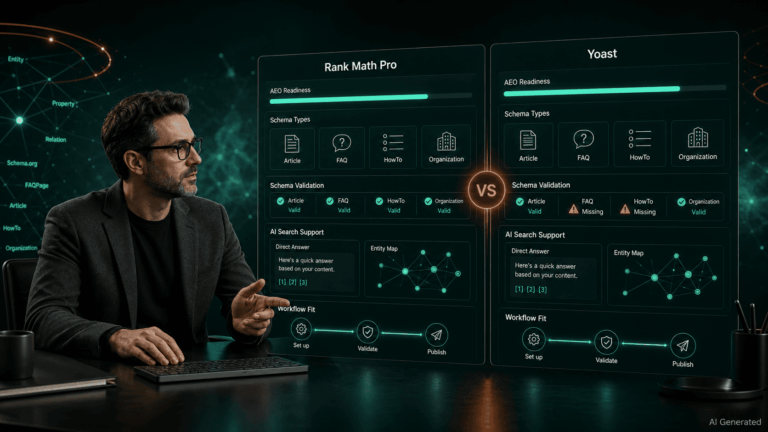
| Rank Math Pro | FAQPage, HowTo, Article, Organization, and 20+ schema types; automated schema generation; schema validation; meta title and description templates aligned with AI Overview formatting | $69/year (Pro) | The non-negotiable GEO tool for every WordPress operation. Rank Math Pro’s FAQPage schema generator — which creates machine-readable Q&A pairs from FAQ sections automatically — is the single most practical GEO implementation available at any price point. Combined with Article schema declaring content entities and Organization schema establishing brand identity, it covers 90% of what structured data can do for GEO. Every WordPress site in this audience should be running Rank Math Pro before any other schema investment. |
| Schema App | Enterprise schema management with nested entity graphs; Organization and brand entity management across multiple properties; schema testing and deployment monitoring; multi-site support | From $99/month | The enterprise alternative for organizations managing complex entity graphs — multiple brands, locations, products, and their relationships — that WordPress plugins cannot model accurately. The nested schema capability (expressing that Person X is an author at Organization Y, which publishes Product Z) produces the entity relationship depth LLMs use to assign domain authority as a citation source. Overkill for most solo and in-house use-cases; essential for enterprise and multi-site operations with compliance or brand governance requirements. |
| Google Rich Results Test | Validates schema markup against Google’s structured data requirements; identifies errors that disqualify content from AI Overview eligibility; previews rich result rendering | Free | Not a management tool — a validation tool. Run every high-priority page through Rich Results Test before publishing and monthly for existing top-performing posts. Schema errors that invalidate FAQPage or Article markup silently remove content from structured data eligibility without generating any ranking change signal. This is the cheapest GEO tool in the stack and one of the most consistently neglected steps in most content operations. |
What Are the Best Tools for Monitoring AI Citations in ChatGPT, Perplexity, and Gemini?
AI citation monitoring — tracking whether your brand or content is referenced inside AI-generated answers outside of Google Search — is the least mature capability in the GEO tool ecosystem. Google AI Overview tracking has been absorbed into mainstream SEO platforms, but monitoring citations in ChatGPT, Perplexity, and Gemini at scale remains genuinely difficult. The tools below represent the current state of the market, with honest assessments of each tool’s limitations.
| Tool | AI Citation Capability | Starting Price | Verdict |
|---|---|---|---|
| Otterly.ai | Monitors brand and keyword mentions inside AI-generated answers from ChatGPT, Perplexity, Gemini, and Copilot; share-of-voice in AI answers; competitor citation comparison; prompt-based visibility scoring | From $49/month | The most practical dedicated AI citation monitoring tool for non-enterprise teams in 2026. Otterly tracks how frequently your brand appears in AI answers for defined prompts — the closest available proxy for real AI search visibility across multiple platforms. Set up tracking for your 10–20 highest-priority GEO keywords and review monthly. Not perfect — AI answer sampling introduces variance — but currently the best available option at this price point for this specific use-case. |
| Profound | AI answer engine analytics with brand visibility, citation share, and competitive positioning across major AI platforms; keyword-level citation trending over time | From $199/month | More comprehensive than Otterly.ai for teams requiring structured citation analytics with historical trend data. Profound’s share-of-voice metric — measuring what percentage of AI answers about your category mention your brand — makes competitive AI visibility reporting concrete enough for stakeholder decks. Best for in-house SEO teams mandated to report AI visibility to leadership and for agencies building GEO performance into client deliverables. |
| GA4 + AI Referral Segments | Tracks actual sessions from ChatGPT.com, Perplexity.ai, Gemini.google.com, and Copilot.microsoft.com as referral traffic; measures engagement and conversion rates for AI-sourced sessions | Free | The only tool in this section that measures actual traffic delivered by AI citations rather than modelling citation presence through prompt sampling. Create custom GA4 segments for each AI platform referral source and review monthly alongside organic performance data. GA4 AI referral data is incomplete — a significant proportion of AI-referred traffic arrives without referrer headers and registers as direct — but it is directionally accurate, costs nothing, and should be the first GEO measurement every site implements before any paid tool. |
| Brandwatch | Enterprise brand monitoring including AI mentions tracking across social platforms, forums, and AI-generated content surfaces; entity tracking; sentiment analysis | Enterprise pricing | Enterprise-only and priced accordingly. Brandwatch’s AI mentions monitoring captures brand references across a broader surface set than GEO-specific tools, including user-shared AI outputs on social platforms. Only justified for brands where AI reputation monitoring — not just AI SEO visibility — is a business priority. Listed for completeness; not recommended for the team sizes most AEO Insider readers operate at. |
The critical limitation of AI citation monitoring in 2026: no tool provides a complete picture. Otterly.ai and Profound model citation presence by querying AI platforms with defined prompts — they do not monitor every query globally. GA4 referral data measures delivered traffic but underreports because many AI platforms strip referrer headers. Use both methods in parallel — one for visibility modelling, one for traffic verification — and treat the combined signal as directional rather than absolute.
What Is the Recommended GEO Tool Stack by Team Type?
A complete GEO stack requires coverage across all four layers: AI Overview tracking, entity content optimization, structured data, and AI citation monitoring. These three configurations cover the most common team types among AEO Insider’s audience.
Stack 1 — Solo Creator / Small Blog (Budget: under $170/month)
- SE Ranking ($65/month) — AI Overview tracking + daily rank monitoring
- Frase ($45/month) — content briefs, PAA-to-H2 structure optimization, entity scoring
- Rank Math Pro ($6/month) — FAQPage + Article schema management in WordPress
- GA4 (free) — AI referral traffic segments for ChatGPT, Perplexity, and Gemini
- Google Rich Results Test (free) — pre-publish schema validation
Total: ~$116/month. Covers all four GEO layers at minimum viable depth. The highest-ROI single upgrade from this stack is replacing Frase with Surfer SEO ($99/month) for more accurate entity scoring and Topical Map planning — add it when content output has reached 2+ posts per week.
Stack 2 — In-House SEO Team (Budget: $350–450/month)
- Semrush Pro ($139.95/month) — AI Overview tracking with citation data + keyword research platform
- Surfer SEO Essential ($99/month) — entity content scoring and Topical Map for cluster planning
- Rank Math Pro ($6/month) — schema management across all posts and pages
- Otterly.ai ($49/month) — AI citation monitoring across ChatGPT, Perplexity, and Gemini
- GA4 (free) — AI referral segments as the ground-truth traffic verification layer
Total: ~$294/month. Semrush handles the AI Overview layer with the citation depth required for stakeholder reporting. Surfer SEO provides entity optimization signal at pre-publish. Otterly.ai adds the ChatGPT and Perplexity citation monitoring that Semrush does not cover. This is the recommended in-house team GEO configuration for 2026.
Stack 3 — Agency Managing Multiple Clients (Budget: $650–900/month)
- Semrush Guru ($249.95/month) — AI Overview tracking across client domains + content marketing toolkit
- Clearscope Essentials ($199/month) — entity scoring with Google Docs integration for client editorial workflows
- Profound ($199/month) — AI citation share-of-voice reporting for client performance deliverables
- Rank Math Pro ($6/month per site) — per-site schema deployment
- GA4 (free per client property) — AI referral segments across all client accounts
Total: ~$655/month + per-site Rank Math costs. The Semrush + Profound combination covers both the Google AI Overview layer and the broader AI citation monitoring that clients increasingly expect as a deliverable. Clearscope’s Google Docs integration handles entity optimization within client editorial workflows that run outside WordPress. This stack produces the reporting depth needed to demonstrate GEO ROI at a client level.
Stay Ahead of AI Search.
Weekly AEO, GEO & AI SEO intelligence for marketers who want their content cited by AI. No fluff.
Frequently Asked Questions
The Bottom Line
GEO tool selection in 2026 comes down to coverage across four layers — AI Overview tracking, entity content optimization, structured data, and AI citation monitoring — with at least one competent tool in each. The solo stack covers all four for around $116/month. The in-house team stack for around $294/month. The agency stack for around $655/month.
The most common GEO tool gap is structured data: most teams are running keyword research and content scoring tools but have not implemented FAQPage schema systematically. The second most common gap is AI citation monitoring beyond Google AI Overviews — Semrush tells you your Google citation rate, but gives you nothing on ChatGPT or Perplexity. Both gaps are fixable with Rank Math Pro and GA4 custom segments before any additional spend is committed.
Start by auditing which of the four GEO layers your current stack does not cover. Add the missing layer using the tool recommended for your team type above. Get it integrated into your content workflow before evaluating anything else. For the complete framework these tools support, read the GEO guide and the citation economy framework.
Written by
AEO Insider Editorial Team
We help modern marketers and operators get their content cited by AI, discovered in search, and wired into scalable growth systems. Our collective focus is entirely on the cutting edge of AEO, GEO, and AI-native SEO.
ABOUT AEO Insider →
One Comment