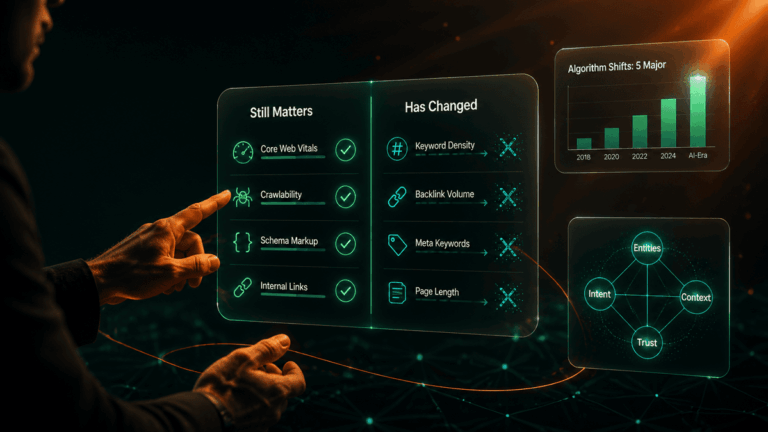
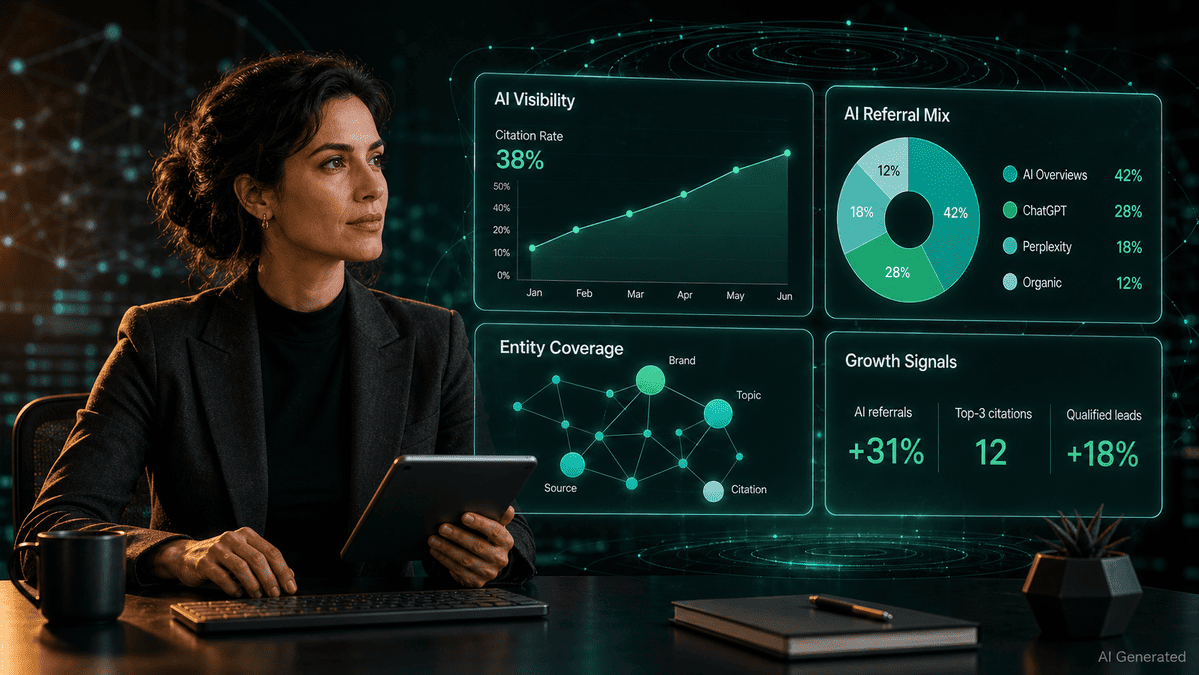
Quick answer: AI-native SEO and GEO require two measurement layers running in parallel: a traditional SEO layer tracking keyword rankings, organic sessions, and click-through rates, and an AI visibility layer tracking AI Overview citations, AI referral traffic from ChatGPT and Perplexity, and brand mention share-of-voice in AI-generated answers. Neither layer alone captures complete search performance in 2026.
The measurement problem in AI-native SEO is not a data shortage — it is a framework gap. Practitioners have more data available than at any point in search history: GA4 session data, Search Console impression and click data, rank tracking data, AI Overview presence data, brand mention data across AI platforms. The gap is a coherent framework that connects these data sources to decisions. Without it, teams track the metrics they have always tracked, miss the AI-specific signals entirely, and report on SEO performance using a measurement system built for a search environment that no longer exists.
The shift from traditional SEO to AI-native SEO changes what matters to measure in three specific ways. First, visibility and clicks decouple — a page cited in a Google AI Overview may generate zero clicks while providing substantial brand exposure and citation authority signals. Second, traffic source diversifies — sessions from ChatGPT, Perplexity, and Gemini arrive through referral channels that require custom GA4 configuration to track accurately. Third, authority is expressed through entity recognition — LLMs evaluate citation worthiness through entity specificity and topical completeness, not through link volume alone, requiring new content-level signals to be added to the measurement stack.
This guide covers the complete KPI framework for AI-native SEO and GEO: the traditional SEO metrics that remain essential, the new AI visibility metrics that complement them, how to configure GA4 to capture AI referral traffic, and how to assemble both layers into a reporting dashboard. For the tools that generate this data, see the Best Tools for GEO and AI Overviews Optimization. For the strategic framework these KPIs measure against, see the complete GEO guide.
Why Do Traditional SEO KPIs Fall Short in an AI-Native Search Environment?
Traditional SEO KPIs were built on a single causal chain: higher rankings produce more impressions; more impressions produce more clicks; more clicks produce more sessions; more sessions produce more conversions. This chain held when search results pages displayed ten blue links and users clicked through to read content. In 2026, the chain breaks at multiple points.
AI Overviews answer informational queries directly on the search results page, producing impressions and brand exposure with zero click-through. A site cited in an AI Overview for ten high-volume keywords may generate no measurable organic sessions from those citations — but may experience significantly increased brand recognition, direct traffic, and AI referral traffic from users who encountered the brand in an AI answer and searched for it directly later. None of this shows up in a traditional organic sessions or click-through rate report.
ChatGPT and Perplexity generate sessions classified as referral traffic in GA4, but only when referrer headers are passed — which a significant proportion of AI platforms do not do, routing traffic to direct instead. A site generating 500 monthly sessions from Perplexity citations may see 150 of those in GA4 as perplexity.ai referrals and 350 as unexplained direct traffic. Traditional reporting attributes the direct traffic to brand awareness efforts and misses the AI citation source entirely.
The fix is not to abandon traditional SEO KPIs — organic rankings, click-through rates, and organic sessions remain essential performance indicators. The fix is to add a second measurement layer that captures the AI-specific signals traditional tools miss, and to report both layers in parallel rather than treating organic session count as the single primary performance indicator for all search channels.
What Are the Core KPIs for AI-Native SEO Performance?
The KPIs below cover both layers of AI-native SEO measurement. The first group — traditional SEO signals — remains essential and unchanged in purpose, though some require AI-aware interpretation. The second group — AI visibility signals — is new and requires additional tooling to measure.
| KPI | What It Measures | Tool | Reporting Cadence | AI-Era Interpretation |
|---|---|---|---|---|
| Organic sessions | Sessions arriving via unpaid search results across all search engines | GA4 | Weekly trend; monthly total | Declining organic sessions without declining rankings may indicate AI Overview cannibalization — users getting answers without clicking. Investigate which keyword clusters are losing CTR while maintaining impressions. |
| Keyword ranking position | Average position in search results for target keywords | SE Ranking, Semrush, Ahrefs | Weekly for top 20 keywords; monthly for full set | Track which ranked keywords now trigger AI Overviews — a keyword ranking #3 with an AI Overview above it has effectively lower click visibility than a keyword ranking #5 without one. |
| Click-through rate (CTR) | Percentage of impressions that produce a click to the site | Google Search Console | Monthly | Falling CTR on informational keywords at stable ranking positions is the primary signal that AI Overviews are intercepting clicks. Segment CTR by keyword intent type to isolate AI cannibalization from general CTR decline. |
| AI Overview presence rate | Percentage of target keywords that trigger an AI Overview in Google Search | Semrush, SE Ranking | Weekly for top 20 keywords; monthly for full set | Track separately from ranking position. High AI Overview presence on your target keywords is both a risk (click interception) and an opportunity (citation eligibility). The question is whether your domain is cited in those overviews. |
| AI Overview citation rate | Percentage of keywords with active AI Overviews where your domain is cited as a source | Semrush AI Overview tracking, Authoritas | Weekly for top 20 keywords | The most direct GEO performance metric available in mainstream tools. A citation rate above 30% on your informational keyword set indicates strong GEO optimisation compliance. Below 10% on keywords where AI Overviews are present signals structural or entity coverage gaps. |
| Organic conversion rate | Percentage of organic sessions completing a defined conversion action | GA4 | Monthly | Segment by landing page to identify which posts are generating sessions but not conversions. Low conversion rate on high-traffic informational posts signals a lead capture gap — the right audience is arriving but no capture mechanism exists. |
What Are the Core KPIs for GEO and AI Citation Visibility?
The AI citation metrics below measure visibility in AI-generated answers across platforms beyond Google Search. This is the measurement layer most SEO operations have not yet built — and the one where the citation economy is generating compounding brand value that traditional reporting misses entirely.
| KPI | What It Measures | Tool | Reporting Cadence | What a Healthy Signal Looks Like |
|---|---|---|---|---|
| AI referral sessions | Sessions arriving from ChatGPT.com, Perplexity.ai, Gemini.google.com, and Copilot.microsoft.com via referrer-passed traffic | GA4 custom referral segments | Monthly | Any positive number is a starting baseline. Month-over-month growth confirms that AI citation volume is increasing. Flat or declining AI referral at growing organic traffic suggests content is ranking but not earning AI citations — a GEO structure issue. |
| Brand mention share-of-voice in AI answers | How often your brand appears in AI-generated answers when users query your topic category across ChatGPT, Perplexity, Gemini, and Copilot | Otterly.ai, Profound | Monthly | Rising share-of-voice over time on category-level prompts (“what are the best tools for GEO optimization”) confirms AI systems are associating your brand with your target topic. Flat share-of-voice despite publishing activity signals entity authority is not accumulating. |
| AI citation count across content library | Total number of posts in the site’s content library that are cited in at least one AI Overview or AI platform answer | Semrush AI Overview tracking (Google); Otterly.ai (ChatGPT/Perplexity) | Monthly | A rising citation count across the library confirms that GEO optimisation — schema, answer blocks, entity declarations — is accumulating authority across the cluster rather than producing isolated wins on individual posts. |
| FAQPage schema validity rate | Percentage of posts with FAQ sections that have active, valid FAQPage schema confirmed by Google Rich Results Test | Google Rich Results Test; Rank Math Pro | Monthly audit of top 20 posts; quarterly audit of full library | Target 100% validity on all posts with FAQ sections. Any post with invalid or missing FAQPage schema is missing its most direct AI citation lever. Schema can be silently invalidated by plugin updates, theme changes, or content edits — monthly validation prevents silent citation loss. |
| Entity coverage score | How comprehensively each post covers the named entities — tools, concepts, organisations — required for citation authority on its target keyword | Frase content score, Surfer SEO Content Score | At publish; quarterly refresh check on top posts | Target Frase score above 75 or Surfer Content Score in the green band at publish. Posts declining below threshold on quarterly checks have been overtaken by competitors adding new entity coverage — refresh those posts before publishing new content on the same cluster. |
| Direct traffic trend | Month-over-month change in sessions arriving as direct (no referrer) | GA4 | Monthly | Rising direct traffic correlated with rising AI citation count is a proxy signal for AI traffic that is not being captured by referrer headers. When AI referral sessions are growing and direct traffic is also growing above baseline, the true AI-referred session count is higher than GA4 referral data shows. |
How Do You Set Up AI Referral Traffic Tracking in GA4?
GA4 does not automatically segment AI platform referrals from other referral traffic — and in default configuration, many AI referral sessions are classified as direct. The setup below creates dedicated segments that surface AI-sourced sessions as a distinct traffic channel, enabling month-over-month trend analysis that is otherwise invisible in standard GA4 reporting.
- Create a custom channel group for AI referrals. In GA4, navigate to Admin → Data Display → Channel Groups → Create New Channel Group. Add a channel called “AI Referral” with the condition: Session source contains “chatgpt.com” OR “perplexity.ai” OR “gemini.google.com” OR “copilot.microsoft.com” OR “claude.ai” OR “you.com”. This creates a permanent channel group that persists in all subsequent reports.
- Build an AI referral exploration report. In GA4 Explore, create a new Exploration. Set the dimension to Session source/medium. Filter for sources matching the AI platform list above. Set metrics to Sessions, Engaged sessions, Average engagement time, and Conversions. Save as “AI Referral Sources” and bookmark it. This report shows AI referral volume by platform, which platform drives the most engaged sessions, and whether AI-referred visitors are converting.
- Add UTM parameters to email and social links referencing AI-cited content. When distributing posts via email or social channels that are known AI citation sources, add UTM parameters (utm_source, utm_medium, utm_campaign) to links. This differentiates sessions arriving directly from email or social distribution versus sessions arriving from AI platforms that may strip referrer headers. Clean UTM data improves the accuracy of the AI referral attribution model.
- Set up a monthly comparison report. In GA4 Reports → Traffic Acquisition, filter by the AI Referral channel group. Set the date comparison to the previous month. Export monthly and add to the AI-native SEO dashboard row in the Notion tracking database. This is the ground-truth data point for the AI traffic layer of the measurement stack.
The GA4 AI referral setup captures only traffic where the AI platform passes a referrer header. Perplexity passes referrers reliably; ChatGPT passes referrers for some but not all traffic; Gemini and Copilot pass referrers inconsistently. Treat the GA4 AI referral figure as a directional floor — the actual AI-driven session count is higher, with the difference partially visible as unexplained direct traffic growth correlated with rising citation counts in your monitoring tools.
How Do You Build an AI-Native SEO Reporting Dashboard?
An AI-native SEO dashboard combines both measurement layers into a single monthly view that enables before-and-after comparisons, trend identification, and layer-specific diagnosis when performance diverges. The dashboard does not replace GA4 or rank tracking tool reports — it aggregates the most decision-relevant metrics from each into one structured record per reporting period.
The recommended dashboard structure is a Notion database with one row per month and the following columns — one for each KPI that requires a monthly update. For the full reporting automation setup, see the AI-Assisted SEO Reporting System.
| Dashboard Section | Metrics | Data Source | Decision It Enables |
|---|---|---|---|
| Traditional SEO layer | Total organic sessions; top 10 keyword ranking positions; average CTR (Search Console); organic conversion rate | GA4, Google Search Console, SE Ranking | Identifies whether organic traffic is growing, flat, or declining and which keyword clusters are responsible |
| AI Overview layer | Keywords with AI Overview presence (count); keywords where domain is cited in AI Overview (count); AI Overview citation rate (%) | Semrush or SE Ranking AI Overview data | Identifies which target keywords carry AI Overview coverage and whether GEO structure is earning citations on those keywords |
| AI referral layer | Total AI referral sessions; sessions by platform (ChatGPT, Perplexity, Gemini, Copilot); AI referral conversion rate | GA4 AI Referral channel group | Identifies which AI platforms are driving the most engaged traffic and whether AI referral is growing month over month |
| Brand AI visibility layer | Share-of-voice in AI answers on top five category prompts; brand mention count across ChatGPT and Perplexity | Otterly.ai or Profound | Identifies whether AI systems are associating the brand with its target topic category and whether that association is strengthening over time |
| Content quality layer | Posts with valid FAQPage schema (count and %); posts with entity coverage score above threshold (count); posts refreshed this month (count) | Rank Math, Frase or Surfer, Google Rich Results Test | Identifies structural compliance gaps across the content library and tracks the refresh cadence that maintains GEO optimisation standards over time |
| Email and capture layer | New email subscribers; lead magnet conversion rate on top three posts; email open rate (week 2 nurture email) | Brevo or ConvertKit, GA4 conversion events | Connects search visibility to subscriber acquisition — confirms that the growth loop is converting AI and organic traffic into the email list that generates authority signals |
Review the dashboard monthly, not weekly. Weekly variance in AI referral sessions and citation counts is noise — directional trends require four to six data points to become legible. The monthly cadence matches the rate at which GEO and AI citation signals actually change, and prevents premature optimisation decisions based on single-week anomalies.
Stay Ahead of AI Search.
Weekly AEO, GEO & AI SEO intelligence for marketers who want their content cited by AI. No fluff.
Frequently Asked Questions
The Bottom Line
AI-native SEO measurement requires two parallel layers: the traditional SEO layer tracking organic sessions, keyword rankings, and click-through rates, and the AI visibility layer tracking AI Overview citations, AI referral traffic from ChatGPT and Perplexity, brand share-of-voice in AI answers, and FAQPage schema validity. Reporting only the traditional layer misses the citation and referral signals that are generating compounding brand value in AI search — value that shows up as direct traffic growth and brand recognition rather than in organic session counts.
The minimum viable measurement stack costs nothing to set up: Google Search Console AI Overviews filter for citation impressions, GA4 AI referral segments for platform-specific traffic, and a weekly manual spot-check on ten target keywords. Add SE Ranking or Semrush for automated AI Overview citation tracking when budget allows. Add Otterly.ai or Profound when multi-platform citation share-of-voice becomes a reporting requirement. Build the dashboard in Notion, update it monthly, and review the trend — not the point-in-time number — at each reporting cycle. For the tools that generate this data, see the GEO tools guide. For the strategic framework these KPIs measure against, see SEO vs AEO vs GEO.

Written by
AEO Insider Editorial Team
We help modern marketers and operators get their content cited by AI, discovered in search, and wired into scalable growth systems. Our collective focus is entirely on the cutting edge of AEO, GEO, and AI-native SEO.
ABOUT AEO Insider →