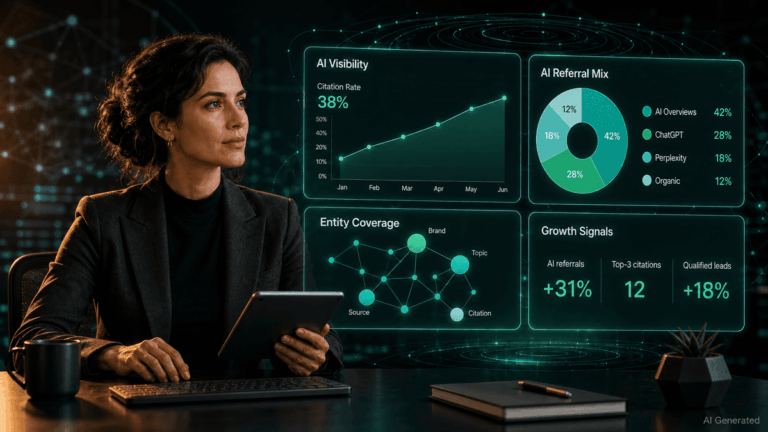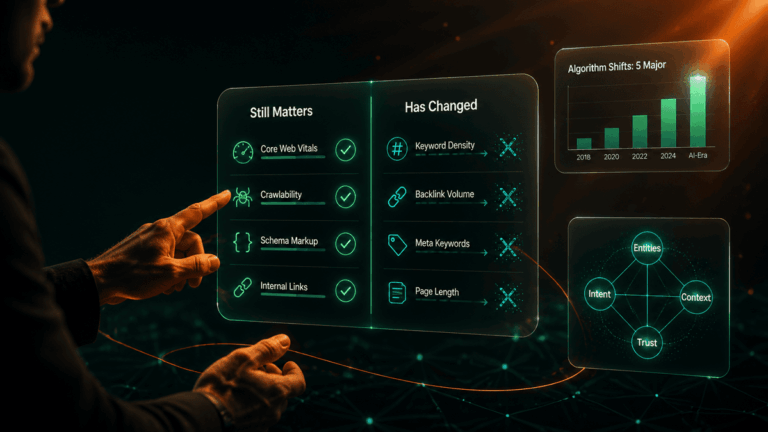
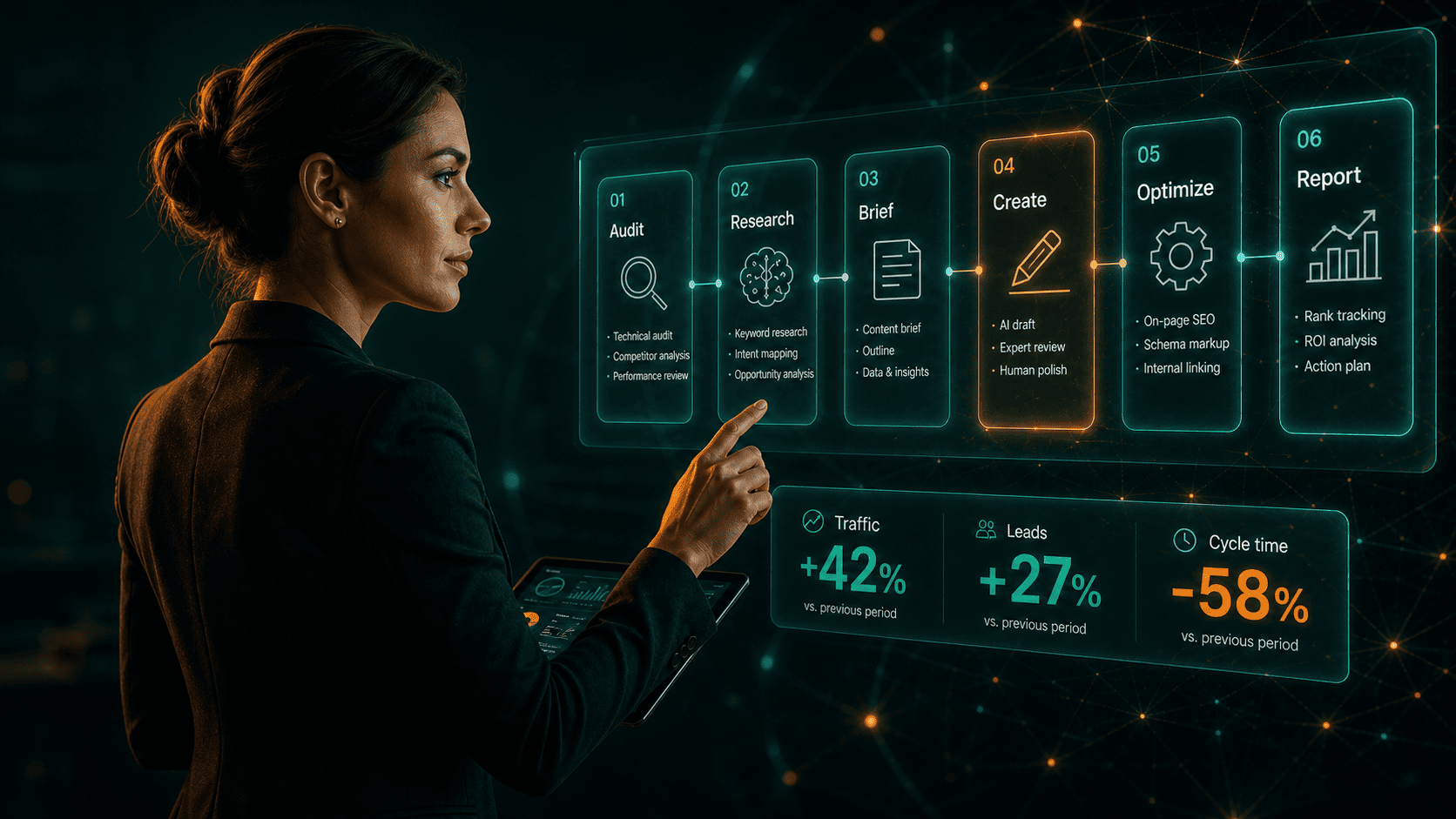
Quick answer: AI SEO agencies deliver results across three service layers: technical and structural optimization for AI readability, GEO content implementation for citation visibility, and AI visibility measurement. The differentiator from traditional SEO is designing content to be cited inside AI-generated answers — not just ranked in search — and measuring citation share across Google AI Overviews, ChatGPT, and Perplexity.
Most AI SEO agency marketing reads the same way: “We optimize your content for AI Overviews and LLMs.” What that actually means in practice — what they do in week one, what they deliver in month three, how they measure whether it is working — is rarely explained. The gap between agency positioning and agency delivery is where most retainer disappointments originate.
AI SEO as a discipline is genuinely different from traditional SEO. The ranking signals are different. The content structure requirements are different. The measurement infrastructure is different. An agency that has repackaged traditional SEO services with AI terminology is not the same as one that has rebuilt its delivery model around Generative Engine Optimization (GEO), Answer Engine Optimization (AEO), and AI citation measurement. The difference matters, and knowing what to look for is the only way to identify it from the outside.
This guide demystifies AI SEO agency service delivery: what separates genuine AI SEO agencies from rebranded traditional ones, how their engagements are structured, what deliverables to expect, and the three metrics that prove an AI SEO agency is actually moving the needle. For the GEO framework underpinning AI SEO agency methodology, see the complete GEO guide. For the AEO framework that governs answer-first content structure, see What Is Answer Engine Optimization.
What Separates an AI SEO Agency from a Traditional SEO Agency?
The marketing distinction is obvious — AI SEO agencies emphasize AI Overviews, LLM optimization, and generative search. The operational distinction is more specific. Genuine AI SEO agencies have rebuilt three core functions: their research methodology, their content production requirements, and their measurement infrastructure. Traditional agencies that have added AI to their positioning have not.
| Function | Traditional SEO Agency | AI SEO Agency |
|---|---|---|
| Research methodology | Keyword volume + difficulty scoring, backlink gap analysis, technical crawl | Entity gap analysis, question graph mapping, AI Overview coverage by keyword, share-of-voice in AI-generated answers |
| Content requirements | Target keyword in title, H1, body; word count targets; readability scores | Answer blocks (40–60 words), question-format H2s, explicit entity naming, FAQPage schema on every post, AI-extractable Q&A structure |
| Schema implementation | Basic Article and BreadcrumbList schema; sometimes FAQPage for rich results | FAQPage schema on all content with FAQ sections, Article schema with explicit about and mentions entity declarations, Organization schema with brand identity |
| Measurement | Rankings in positions 1–10, organic sessions, backlinks acquired, domain authority | AI Overview citation rate, share-of-voice in ChatGPT/Perplexity/Gemini, ranking velocity on new content, AI referral sessions from GA4 |
| Content briefing | Keyword density targets, competitor word count benchmarks, LSI keyword lists | Entity coverage requirements, answer block template, PAA-sourced H2 structure, schema output specification per article |
The single clearest diagnostic is the measurement layer. Ask any AI SEO agency prospect how they report on AI citation visibility. If the answer involves traditional rank tracking software and position 1–10 data, the agency has rebranded. If the answer involves Otterly.ai, Profound, or GA4 AI referral segments — and they can explain the difference between AI Overview citation rate and share-of-voice in conversational AI answers — the agency has rebuilt.
How Do AI SEO Agencies Structure Their Core Service Delivery?
AI SEO agency service delivery typically operates across three service layers, sequenced in the order that produces compounding results. The sequence matters — skipping the foundation layer to go straight to content production is the most common engagement structure error, and it explains why many AI SEO retainers plateau early.
Layer 1 — Foundation (typically weeks 1–6): Technical and structural work that makes the site AI-readable. This includes schema audit and implementation (FAQPage, Article, Organization), entity definition (ensuring the brand, its products, and its key concepts are named and described consistently across the site), internal linking architecture (creating topical clusters that allow AI systems to navigate related content), and site speed and crawlability baseline. Without this layer, content production in Layer 2 produces correctly structured posts sitting on a site that AI systems cannot efficiently parse or trust.
Layer 2 — Content production (ongoing): The systematic output of GEO and AEO-optimized content against a topical map. This means content briefs specifying entity requirements, answer block position and word count, question-format H2 structure sourced from PAA data, and FAQPage schema specification for every post. High-performing AI SEO agencies have a documented brief-to-publish workflow with quality checkpoints — not a freestyle content production process with AI tools used ad hoc.
Layer 3 — Measurement and iteration (ongoing from month 2): The infrastructure that tracks whether the work in Layers 1 and 2 is producing AI visibility. This layer includes weekly AI Overview coverage monitoring (using Semrush or SE Ranking), monthly AI citation share-of-voice reporting (Otterly.ai or Profound), GA4 AI referral traffic segmentation, and quarterly topical authority gap reviews. Agencies that do not have this layer built are not measuring GEO outcomes — they are measuring traditional SEO outcomes and calling it AI SEO.
What Does a Typical AI SEO Agency Engagement Actually Look Like?
Most AI SEO agency engagements follow a four-phase structure. The timing varies by agency and client complexity, but the phase sequence is consistent across competent providers.
| Phase | Timeline | Core Work | Output |
|---|---|---|---|
| Discovery and audit | Weeks 1–2 | Existing content AI-readiness audit, competitor AI visibility analysis, keyword and entity mapping, AI Overview baseline measurement | Audit report, AI visibility baseline, 90-day roadmap |
| Foundation implementation | Weeks 3–6 | Schema implementation across existing content, entity optimization on top-performing pages, internal linking architecture build, GA4 AI referral segment setup | Schema live on site, GA4 configured, entity documentation |
| Content production | Month 2 onwards | Topical map execution — brief generation, AI-assisted drafting, editorial review, schema implementation, publish. Typically 4–12 posts per month depending on retainer scope. | Published, GEO-optimized content against topical plan |
| Measurement and optimization | Month 2 onwards (parallel) | AI Overview citation monitoring, GA4 AI referral tracking, ranking velocity on new posts, monthly reporting, quarterly gap review and roadmap update | Monthly performance report, quarterly strategy update |
The discovery phase output — the audit report and 90-day roadmap — is the clearest early signal of agency capability. A competent AI SEO agency audit covers AI Overview coverage by keyword, FAQPage schema presence across existing content, entity definition consistency, internal linking architecture, and GA4 AI referral traffic baseline. An audit that covers only technical crawl errors and traditional on-page SEO factors is a traditional SEO audit with an AI SEO price tag.
What Deliverables Should You Expect from an AI SEO Agency?
Deliverable expectations vary by retainer scope, but a competent AI SEO agency should produce the following on a defined cadence regardless of budget level:
| Deliverable | Cadence | What It Proves |
|---|---|---|
| AI Overview citation report | Monthly | Whether published content is being cited in Google AI Overviews on target keywords — the primary GEO performance indicator |
| AI referral traffic report (GA4) | Monthly | Actual traffic delivered from ChatGPT.com, Perplexity.ai, and Gemini.google.com — the ground-truth citation signal |
| Content published vs. plan | Monthly | Whether the content production commitment is being met; basis for output-based ROI calculation |
| Ranking velocity report | Monthly | Days from publish to first top-50 ranking on new posts — measures structural quality and topical authority compounding |
| Topical authority gap analysis | Quarterly | Which content clusters have coverage gaps that reduce the site’s citation authority on key topics |
| Entity coverage audit | Quarterly | Whether key entities (brand, products, concepts) are named, defined, and interlinked consistently across the site |
| 90-day roadmap update | Quarterly | Revised content and technical priorities based on measured performance — evidence the agency is adapting strategy, not running on autopilot |
The deliverable that most clearly separates capable agencies from mediocre ones is the quarterly entity coverage audit. Traditional SEO agencies do not produce this. It requires mapping every key entity mentioned across the site against a defined entity graph — checking that the brand, its products, its key concepts, and their relationships are named and described consistently enough for AI systems to extract citations confidently. Agencies that cannot produce this deliverable have not built the entity-first content methodology that GEO-optimized content requires. For the tool stack that supports this methodology, see Best AI SEO Tools for 2026.
How Do You Evaluate Whether an AI SEO Agency Is Actually Delivering Results?
Three metrics prove AI SEO agency performance. If a retainer is not moving all three in the right direction within 90 days, the engagement is underperforming or the agency is not genuinely operating as an AI SEO agency.
- AI Overview citation rate on new content. Of the posts published during the engagement on keywords with active AI Overview coverage, what percentage have earned AI Overview citations? A well-structured GEO engagement should produce AI Overview citations on 30–50% of eligible posts within 60 days of publication. Below 10% after 90 days on eligible keywords suggests structural compliance issues — missing answer blocks, missing FAQPage schema, or insufficient entity coverage.
- Ranking velocity on new posts. Days from publish to first top-50 ranking is the most sensitive indicator of content structural quality. GEO-optimized content — with clear answer blocks, question-format H2s, entity naming, and FAQPage schema — typically earns first rankings faster than structurally generic content on equivalent keywords. If ranking velocity is not improving over the first 90 days, the content production methodology is not producing structurally superior content.
- AI referral traffic in GA4. Monthly sessions from ChatGPT.com, Perplexity.ai, and Gemini.google.com should be measurable and trending upward by month three. Zero AI referral traffic after 90 days on a site publishing GEO-optimized content is a signal that the content is either not being indexed efficiently or not being cited in AI-generated answers despite AI Overview tracking data suggesting otherwise. GA4 AI referral sessions are the ground-truth check on citation modelling data.
Red flags that indicate a rebranded traditional agency: reporting that only covers traditional rankings; no FAQPage schema on content produced during the engagement; no AI Overview citation data in monthly reports; no GA4 AI referral segment; content briefs that specify keyword density rather than entity coverage requirements.
Green flags that indicate genuine AI SEO capability: entity-level reporting showing which brand entities are being cited; AI Overview coverage trending up on target keyword clusters; GEO-structured content with answer blocks and schema present on every published post; measurement infrastructure that separates Google AI Overview citations from ChatGPT and Perplexity citations as distinct signals. For the automation stack that powers AI SEO agency delivery at scale, see the Marketing Automation Stack for AI-Native SEO.
Stay Ahead of AI Search.
Weekly AEO, GEO & AI SEO intelligence for marketers who want their content cited by AI. No fluff.
Frequently Asked Questions
The Bottom Line
AI SEO agencies that deliver genuine results operate across three service layers in sequence: foundation (schema, entity definition, site architecture), content production (GEO and AEO-structured output against a topical map), and measurement (AI Overview citation tracking, AI referral traffic, share-of-voice reporting). The agencies that do not deliver results have one or more of these layers missing — most commonly the measurement layer, which is the only way to know whether the foundation and content work is producing AI citation outcomes.
The three metrics that prove performance are AI Overview citation rate on new content, ranking velocity on published posts, and GA4 AI referral sessions. If all three are not moving in the right direction within 90 days, either the engagement is underperforming or the agency is not genuinely operating as an AI SEO provider. Use those three numbers as your evaluation framework — not rankings reports, not traffic dashboards, not content scores. For the GEO framework that underpins genuine AI SEO agency methodology, read the complete GEO guide. For the decision framework on whether to hire an agency or do it yourself, read the next article in this series.
Written by
AEO Insider Editorial Team
We help modern marketers and operators get their content cited by AI, discovered in search, and wired into scalable growth systems. Our collective focus is entirely on the cutting edge of AEO, GEO, and AI-native SEO.
ABOUT AEO Insider →