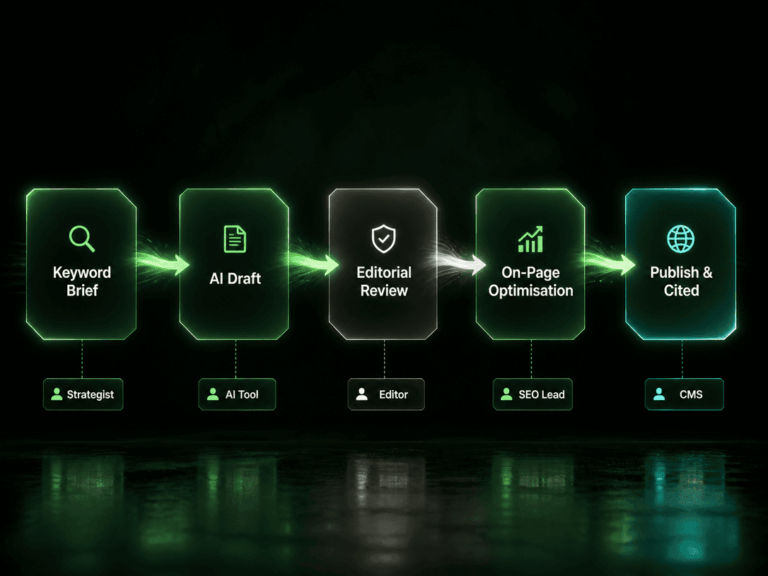

Quick answer: Human-in-the-loop AI content QA is a structured review process where a human editor validates AI-generated drafts against four criteria: factual accuracy, structural compliance, brand voice alignment, and E-E-A-T signal quality. It is not a full rewrite — it is targeted intervention at the specific points where AI reliably fails and human judgment reliably adds measurable value.
The most dangerous assumption in an AI-assisted content operation is that a well-structured prompt produces a publish-ready draft. It does not. AI language models produce structurally compliant, grammatically correct, and topically relevant content with impressive consistency — and they fabricate specific claims, misattribute sources, flatten brand voice, and fail E-E-A-T signals with equal consistency. A team that publishes AI drafts without a systematic QA process is not running an efficient content operation. It is running a liability.
The solution is not to abandon AI drafting — the efficiency gains are real and the structural compliance benefits for GEO are significant. The solution is a human-in-the-loop QA process that is scoped precisely: catching the failures AI reliably produces without duplicating the work AI handles well. The teams operating this correctly spend 40–60 minutes on QA per post, not two hours — and they catch the specific errors that would otherwise damage search authority, reader trust, or brand consistency.
This guide documents the QA process, the most common AI content failure modes, a stage-by-stage checklist, and the tools that support efficient human review at the end of the AI content workflow. For the brief-to-draft stage that precedes QA, see Prompt Systems for AI SEO Briefs.
What Is Human-in-the-Loop AI Content QA?
Human-in-the-loop (HITL) AI content QA is the stage in an AI-assisted content workflow where a human editor reviews, validates, and intervenes in an AI-generated draft before publishing. It is defined by scope: a HITL QA process identifies the specific failure modes AI produces and targets human effort at correcting those failures — not at rewriting sections the AI handled well.
The distinction matters because the most common approach to AI content review is undisciplined. Editors open an AI draft and rewrite anything that does not sound like their voice — producing a hybrid document that takes as long as a fully human-written post and defeats the efficiency purpose of AI drafting entirely. A scoped HITL process is the opposite: it defines what to check, in what order, using what criteria, and stops when those checks are complete.
The four domains a HITL QA process covers:
- Factual accuracy. AI models confabulate specific claims — statistics, dates, product features, named examples — with the same syntactic confidence as verified facts. Every specific, verifiable claim in the draft must be checked against a primary source before publishing.
- Structural compliance. Even well-prompted AI drafts drift from brief requirements — answer blocks run long, H2s slip back to statement format, FAQ questions duplicate body content. The QA pass checks every structural requirement from the brief is present and correctly formatted.
- Brand voice alignment. AI drafts converge on a homogeneous tone — technically correct, reasonably clear, and generically professional. Brand voice requires specific phrasing patterns, perspective signals, and tonal calibration that must be applied in the QA pass, not in the prompt.
- E-E-A-T signal quality. Experience, Expertise, Authoritativeness, and Trustworthiness signals — specific examples, first-person practitioner observations, data with sourced citations, named entities with defined relationships — are consistently underweighted in AI drafts and must be added during human review.
What Are the Most Common AI Content Quality Failures?
Understanding which failures AI produces systematically — not occasionally — is what makes a QA checklist efficient. These are the predictable outputs of how language models generate text, regardless of model quality or prompt sophistication.
| Failure Type | What It Looks Like | Why AI Produces It | QA Fix |
|---|---|---|---|
| Confabulated statistics | “Studies show that 73% of marketers…” with no source | LLMs complete statistical sentence patterns without verifying figures | Check every percentage, number, and named study against a primary source; delete or replace anything unverifiable |
| Generic persona language | “Many businesses find that…” / “Organizations often struggle with…” | AI defaults to inclusive hedging language to avoid specificity it cannot verify | Replace with specific audience language: “Most in-house SEO teams under ten people…” |
| Flat introduction paragraphs | Long preamble explaining what the article will cover before making any substantive claim | AI mirrors training data that frequently front-loads context before content | Delete or rewrite the first paragraph of each section to lead with the most useful claim |
| Duplicated FAQ content | FAQ answers that restate body content verbatim rather than adding new information | AI generates FAQ answers from the same source material as body paragraphs | Rewrite FAQ answers to address the question from a different angle or with additional specificity not in the body |
| Missing authority signals | Third-person generalizations where a practitioner perspective would add authority | AI has no first-person experience to draw from | Add one specific practitioner observation per H2 section that reflects direct knowledge of the topic |
| Misattributed tool features | Specific features attributed to tools that do not offer them, or to the wrong product | LLMs conflate similar tools and hallucinate feature sets | Verify every tool-specific capability claim against the tool’s current documentation |
What Does a Human-in-the-Loop AI Content QA Process Look Like?
An effective HITL QA process runs in five stages, each with a defined scope and time allocation. The sequence matters: structural compliance is checked before prose quality because fixing structural issues often requires rewriting prose anyway — checking prose first wastes effort on sections that will change.
| Stage | What to Check | Time | Tool |
|---|---|---|---|
| 1. Structural audit | Quick Answer block present and under 60 words; all H2s phrased as questions; FAQ section has five distinct questions; minimum two internal links present; Bottom Line section closes the post | 5 min | Visual scan in WordPress editor |
| 2. Factual verification | Every statistic, percentage, date, named study, and tool-specific feature claim; flag each; verify against primary source; delete or replace anything unverifiable | 15–20 min | Perplexity Pro or direct source check; source log in Notion |
| 3. Voice and specificity pass | Replace generic persona language with specific audience language; rewrite flat introduction paragraphs to lead with the most useful claim; add one practitioner observation per H2 section | 15–20 min | Direct editing in WordPress; brand voice guidelines in Notion Content OS |
| 4. E-E-A-T signal check | Named entities declared at first use with context; at least two external citations linking to primary sources; FAQ answers add information not already in the body; author byline visible | 5–10 min | Read-through; add citations where missing |
| 5. Schema and on-page validation | FAQPage schema active in Rank Math; Article schema enabled; meta title and description set; content score above target threshold | 10 min | Rank Math, Frase or Surfer SEO, Google Rich Results Test |
Total QA time: 50–65 minutes per post. This is the correct ceiling for a scoped HITL process. Posts that regularly exceed this allocation are using under-specified briefs — producing drafts that require more reconstruction than review — or applying undisciplined editing that treats QA as a full rewrite. Both problems are solved upstream in the prompt and brief stage, not in QA.
What Separates a QA Checklist That Scales from One That Becomes a Bottleneck?
Most QA checklists fail at scale for one of two reasons: they are too long to use consistently, or they are not specific enough to catch the failures they were designed for. A checklist with thirty line items gets skipped under time pressure. A checklist that says “check tone” provides no actionable guidance on what to change.
The characteristics of a QA checklist that holds at publishing volume:
- Binary checks only. Every item on the checklist is either present or not — not graded. “Quick Answer block present and under 60 words” is binary. “Writing quality is good” is not a check.
- Scoped to AI failure modes. The checklist only covers what AI reliably gets wrong. It does not cover what good human writing looks like in general — that belongs in the style guide, not the QA checklist.
- Sequenced by dependency. Structural checks before prose checks before schema checks. Reversing this order produces rework when structural fixes require prose changes.
- Stored in the production workflow. The checklist lives as a Notion template attached to every content brief record — not in a separate document. When a post moves to QA status in the Notion Content OS, the QA checklist is already embedded in the record.
- Updated when new failure patterns emerge. AI model updates introduce new failure modes. Add new checklist items when a failure pattern appears in more than two consecutive posts — not after a single occurrence.
The single most effective structural change to a failing QA process is reducing the checklist to ten or fewer binary items and enforcing those consistently before adding any new checks. Compliance with a short checklist outperforms selective compliance with a comprehensive one every time.
What Are the Best Tools for AI Content Quality Assurance?
The tools below address specific QA stages rather than the full process. No single tool covers all five stages — the stack pairs each tool against the stage where it adds the most specific value, keeping the QA workflow from requiring tool switches mid-stage.
| Tool | QA Stage | Capability | Starting Price | Verdict |
|---|---|---|---|---|
| Perplexity Pro | Factual verification | Sourced research with linked primary citations; real-time web retrieval for claim verification; cited summaries for statistics and named studies | $20/month | The fastest factual verification tool in the QA stack. Paste a specific claim and ask Perplexity to verify it with primary sources — the cited response either confirms the claim with a source or surfaces the correct figure. Faster than manual search and more reliable than asking the drafting LLM to self-verify. |
| Frase | Structural and entity audit | Content score against top-ranking pages; entity coverage gap analysis; recommended word count; PAA question comparison for FAQ completeness | $45/month | Best structural and entity QA tool at a solo budget. The content score provides an objective entity coverage check that removes subjectivity from “did we cover this topic fully?” Run it at Stage 4 of QA, after structural and voice edits are complete, to identify entity gaps before publishing. |
| Surfer SEO | Structural and entity audit | Real-time Content Score in editor; NLP-based entity requirements; SERP comparison for structure benchmarking | $99/month | More accurate entity scoring than Frase on complex and technical topics. The real-time Content Score integrates structural and entity QA into the editing stage rather than requiring a separate tool switch. Recommended for in-house teams where entity precision is a competitive differentiator on target keywords. |
| Rank Math Pro | Schema and on-page validation | FAQPage schema generation from FAQ content; Article schema with entity declarations; SEO score; meta field validation | $69/year | Non-negotiable for WordPress operations. Rank Math’s FAQPage schema auto-generation from the post’s FAQ section removes the manual schema step entirely — the QA check is simply confirming the toggle is enabled and the Rich Results Test passes. Run Google Rich Results Test as the final QA gate before any post goes live. |
Stay Ahead of AI Search.
Weekly AEO, GEO & AI SEO intelligence for marketers who want their content cited by AI. No fluff.
Frequently Asked Questions
The Bottom Line
Human-in-the-loop AI content QA is a scoped, staged process — not a license to rewrite everything an AI draft produced. The five stages cover structural compliance, factual verification, voice alignment, E-E-A-T signals, and schema validation. The full process runs in 50–65 minutes. The minimum viable version for a solo operator runs in 30 minutes across three non-negotiable checks: factual verification, structural audit, and schema validation.
The most common reason QA fails at scale is undefined scope — reviewers making undirected quality judgments rather than executing a binary checklist. Build the checklist into the Notion Content OS as a template attached to every brief record. Make QA completion a required status gate before a post moves to published. The checklist enforces the process; the process enforces the quality. For the brief and prompt system that determines how much work QA has to do, see Prompt Systems for AI SEO Briefs.

Written by
AEO Insider Editorial Team
We help modern marketers and operators get their content cited by AI, discovered in search, and wired into scalable growth systems. Our collective focus is entirely on the cutting edge of AEO, GEO, and AI-native SEO.
ABOUT AEO Insider →