
Quick answer: AI prompt governance is the system of documented rules, templates, and processes that ensures every team member prompts AI tools consistently, within brand voice guidelines, and against a shared knowledge base. Without it, a five-person content team produces five distinct content voices from the same LLM — none of them reliably matching the brand or meeting structural requirements.
AI content operations fail in a predictable way when they scale past one person. A solo operator who has built and refined a working prompt can produce consistent, on-brand, structurally compliant content reliably. Add a second person without a shared prompt library and style guide, and you get two different tones, two different structural interpretations, and two different assumptions about what “brief compliance” means. Add a third and the divergence compounds. What looked like a solved system at individual scale breaks down the moment it depends on more than one person following undocumented conventions.
Governance is what prevents that breakdown. Not governance in the compliance-department sense — not policies, committees, or approval chains. Governance in the operational sense: a shared knowledge base, a versioned prompt library, a documented style guide, and a clear process for updating all three when the content strategy or AI model changes. These four assets are the difference between an AI content operation that scales and one that produces inconsistent output that requires escalating QA effort to manage.
This guide covers all four elements in sequence: what each is, how to build it, and how to connect them into a governance system that holds at publishing volume. For the QA process that operates downstream of governance, see Human-in-the-Loop AI Content QA. For the brief and prompt templates that governance standardises, see Prompt Systems for AI SEO Briefs.
What Is AI Prompt Governance and Why Does It Matter?
AI prompt governance is the operational framework that controls how AI tools are used within a content team — specifically: which prompts are approved for which content types, what context and constraints must be included in every prompt, how prompts are versioned and updated, and who can modify the prompt library. It answers the question every scaling AI content team eventually faces: how do we ensure that the AI outputs from five different people are consistent enough to be the same brand?
The reason governance matters at scale is that LLMs are context-sensitive. The same model produces dramatically different output depending on the system prompt, the context provided, the constraints specified, and the examples included. Two team members using the same model with different prompts for the same content type will produce different structural patterns, different tonal registers, and different levels of entity specificity — not because one is more skilled, but because they are giving the model different instructions. Governance standardises those instructions.
The three things governance is not: it is not a restriction on creativity or individual judgment; it is not a process for getting AI outputs approved before publishing (that is QA, not governance); and it is not a one-time setup task. Prompt governance is a living operational asset that requires the same maintenance cadence as the content strategy it serves.
What Are the Core Elements of a Prompt Governance System?
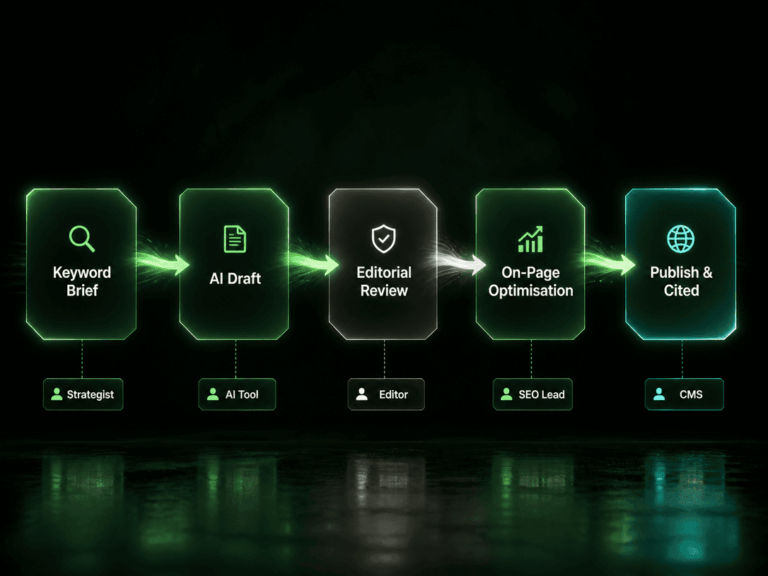
A complete prompt governance system has four components. Each can be built independently, but they produce full operational value only when connected — the knowledge base informs the prompts; the prompts enforce the style guide; the style guide defines what QA is checking for.
| Component | What It Is | What It Controls | Where It Lives |
|---|---|---|---|
| Prompt library | A versioned collection of approved system prompts and task prompts, organised by content type and use case | What instructions the LLM receives for each content type; structural requirements; tone constraints; output format | Notion database with prompt type, version, model, last tested date, and output examples |
| Style guide | A documented set of brand voice rules, terminology standards, and prohibited language patterns | How content sounds; which terms to use and avoid; sentence structure preferences; perspective (first vs. third person) | Notion page linked from every brief template and prompt; referenced in QA checklist |
| Knowledge base | A curated repository of approved facts, product descriptions, competitor positioning, audience definitions, and entity definitions | What factual context the LLM has access to; which claims can be made without verification; how the brand and its products are described | Notion database with fact type, source, last verified date, and approved usage examples |
| Update protocol | A documented process for proposing, testing, approving, and versioning changes to any of the three components above | Who can change prompts; how changes are tested before rollout; how old versions are archived; when to trigger a review | Notion SOP page; linked from the prompt library and style guide |
The minimum viable governance system for a solo operator starting out is a prompt library and a style guide. The knowledge base and update protocol become necessary when team size increases, when a new AI model is introduced, or when content quality variance across posts is high enough to require systematic diagnosis.
How Do You Build a Prompt Library That Teams Actually Use?
The failure mode of prompt libraries is not that teams build them wrong — it is that teams build them and do not use them. A prompt library that exists in a shared Google Doc, requires scrolling past forty prompts to find the right one, and has not been updated in three months is not operational governance. It is a filing cabinet. The characteristics of a prompt library teams actually use:
- Organised by task, not by model or date. Team members look for prompts by what they are trying to do — “write a long-form article,” “generate FAQ questions,” “rewrite an introduction paragraph” — not by when the prompt was created or which model it was written for. The library structure should mirror how people think about tasks, not how prompts were historically catalogued.
- Each prompt includes a tested example output. A prompt without an example output is a template without a benchmark. Every approved prompt in the library should include one example of the output it produces when run correctly — so team members can verify their output matches the expected pattern before investing in the full draft.
- Version numbers and last-tested dates are visible. AI models update. A prompt that worked well with one model version may produce degraded output with the next. Every prompt entry should show which model it was tested on, when it was last validated, and what version it is. Prompts without these fields are prompts that cannot be maintained.
- It lives one click from the content brief. If accessing the prompt library requires navigating to a different tool or workspace, team members will not use it under time pressure. In the Notion Content OS, the relevant prompt is linked directly from the brief template for each content type — one click from the brief to the approved prompt for that post format.
- A feedback mechanism exists. Team members who discover that an approved prompt produces inconsistent or degraded output need a documented way to flag it. A simple Notion property — “flag for review” with a comments field — surfaces problems to whoever maintains the library without requiring a meeting or email thread to initiate a change.
How Do You Maintain Brand Voice Consistency Across AI-Generated Content?
Brand voice consistency in AI-generated content requires a written style guide that is specific enough to be operationally useful — not a set of adjectives (“authoritative, approachable, clear”) that describe a desired feeling without giving the LLM or the human reviewer anything to act on. An operational style guide translates voice characteristics into rules that can be checked, prompted against, and verified in QA.
| Voice Element | Vague Version | Operational Version | Where Applied |
|---|---|---|---|
| Tone | “Authoritative but approachable” | “Write as a senior practitioner explaining to a peer, not as a professor explaining to a student. No academic hedging. No passive voice in opening sentences.” | System prompt; QA checklist |
| Persona language | “Speak to our audience” | “Audience is senior digital marketers and agency owners. Replace ‘many businesses’ with ‘most SEO teams under 20 people’. Replace ‘organizations’ with specific team types.” | System prompt; brief template |
| Prohibited terms | “Avoid marketing fluff” | “Never use: revolutionary, game-changing, unlock your potential, seamless, robust, leverage (as a verb), cutting-edge. Flag any of these in QA.” | QA checklist; style guide reference in prompt |
| Sentence structure | “Keep it concise” | “Opening sentence of each section: maximum 20 words, active voice, leading with the most useful claim. No preamble sentences that explain what the section will cover.” | System prompt; QA stage 3 |
| Data and claims | “Be specific” | “Every claim requires a specific referent: not ‘most teams’ but ‘most in-house SEO teams managing more than three client accounts’. Specific claims require a source. General claims do not.” | Brief template; QA stage 2 |
The style guide serves two functions simultaneously: it is the instruction set for the prompt (“write in this voice, avoid these patterns, use this sentence structure”), and it is the benchmark for QA (“does this draft comply with these rules?”). A style guide that is too abstract to operationalise in a prompt is also too abstract to check in QA — both uses require the same level of specificity.
What Does a Knowledge Base Structure Look Like for AI Content Teams?
A knowledge base for an AI content team is not a general information repository — it is a curated set of approved facts, definitions, and descriptions that get injected into prompts or referenced during QA to ensure factual consistency across all content. The distinction matters: a general repository grows without bound and becomes unusable; a curated knowledge base contains only what the AI needs to produce accurate, on-brand content without confabulating brand-specific claims.
The five knowledge base categories that produce the most operational value for an AI SEO content team:
- Entity definitions. Approved definitions for every core entity the brand publishes about — GEO, AEO, AI Overviews, LLM optimization — with the exact phrasing the brand uses for each term. These definitions go into the system prompt for every article so the LLM uses consistent entity language rather than generating its own variant each time.
- Approved external citations. A maintained list of authoritative external sources the brand cites regularly — specific Semrush studies, Google Search Central documentation, named research reports — with current URLs verified for link rot monthly. The LLM references these rather than hallucinating plausible-sounding but unverified sources.
- Product and tool descriptions. For operations that write about their own products or regularly featured tools, a fact sheet with current pricing, features, and positioning for each product. These get injected into prompts for relevant content types so the LLM produces accurate product descriptions rather than confabulated feature sets.
- Audience definitions. Approved descriptions of each reader persona — role, seniority, context, goals, and the specific language patterns each persona uses to describe their problems. These go into the system prompt persona clause so the LLM calibrates specificity and vocabulary to the right audience for each content type.
- Internal link registry. A maintained list of published posts with their current URLs and target keywords, updated when new posts are published and when slugs change. This is referenced during brief creation and QA to ensure internal links are accurate — slug changes after publication are a common source of broken internal links that the knowledge base prevents.
The internal link registry is the highest-friction knowledge base asset to maintain and the one with the most immediate operational impact. A Notion database with one row per published post — title, URL, target keyword, publish date, category — takes 15 minutes to update after each new publication and prevents every subsequent post from generating broken internal links based on outdated slugs.
Stay Ahead of AI Search.
Weekly AEO, GEO & AI SEO intelligence for marketers who want their content cited by AI. No fluff.
Frequently Asked Questions
The Bottom Line
AI content governance is the operational infrastructure that makes a one-person content system scalable and a multi-person content system consistent. It has four components — a prompt library, a style guide, a knowledge base, and an update protocol — each with a defined scope and maintenance cadence. A solo operator needs the prompt library and style guide from the start. The knowledge base and update protocol become critical when team size increases or content quality variance is high enough to require systematic diagnosis.
The most common governance failure is building the system and not maintaining it. A prompt library with outdated model versions and a style guide that predates the last brand refresh are worse than no governance — they give team members false confidence that they are following approved standards when they are not. Build the update protocol before it is needed: assign ownership, set cadences, and create the flagging mechanism for team members who encounter output that does not match the benchmark. Governance that is maintained is what separates an AI content operation that scales from one that produces increasing QA overhead as it grows. For the QA process that operates downstream, see Human-in-the-Loop AI Content QA. For the Notion system that houses the governance assets, see the Notion Content OS.

Written by
AEO Insider Editorial Team
We help modern marketers and operators get their content cited by AI, discovered in search, and wired into scalable growth systems. Our collective focus is entirely on the cutting edge of AEO, GEO, and AI-native SEO.
ABOUT AEO Insider →