
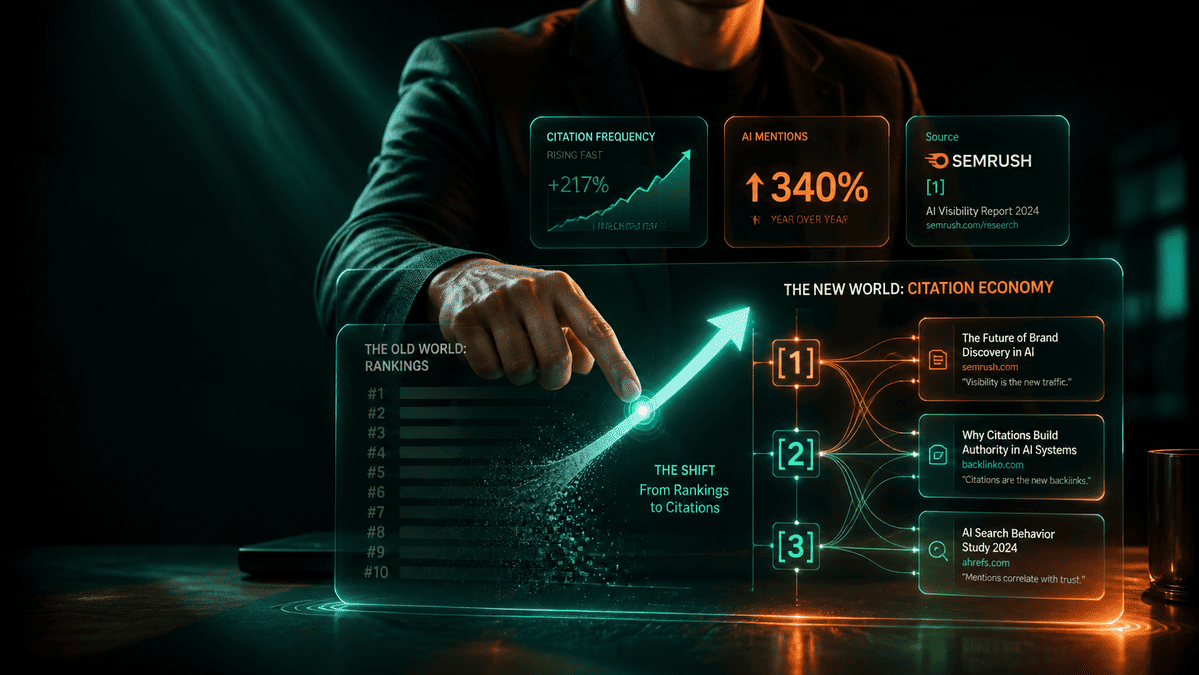
Quick answer: The citation economy refers to the emerging model of AI search visibility in which being named and cited inside an AI-generated answer — in Google AI Overviews, ChatGPT, Perplexity, or Gemini — delivers measurable traffic and authority that is increasingly independent of traditional ranking position. In this model, a page cited at position six can outperform a page ranking at position one if the cited page appears inside the AI answer that millions of users read instead of scrolling to the organic results.
For most of SEO’s history, visibility meant one thing: ranking position. The closer to position one, the more clicks. This model worked because searchers had to scroll through a list of results to find answers. The ranked page was the answer delivery mechanism — there was no alternative route to the information.
AI-generated answers change this structure fundamentally. When a query triggers a Google AI Overview, a Perplexity summary, or a ChatGPT response, the user receives a synthesised answer before they see any ranked result. Many users read that answer and stop. The pages cited inside that answer receive attribution — and often traffic — while pages ranked below the AI module may receive nothing at all, regardless of their position.
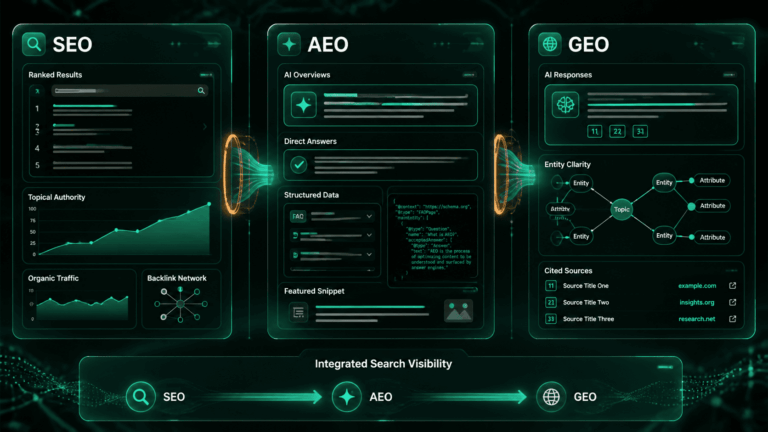
This is the citation economy: a parallel visibility layer where the currency is not rank but citation, and where the rules of earning that citation are different from the rules that govern rankings. This article covers what the citation economy is, which platforms it operates across, what kinds of content earn citations consistently, and how to measure and optimise for citation visibility. For context on the broader framework this fits within, see the complete SEO vs AEO vs GEO guide.
What Is the Citation Economy in AI Search?
The citation economy is a framework for understanding how value flows in AI-first search. In traditional search, value flows through ranked position: higher rank, more clicks, more revenue. In the citation economy, value flows through attribution: being named as a source inside an AI-generated answer that a user trusts and acts on.
The analogy to academic citation is deliberate. In academic publishing, being cited by other researchers is a signal of authority — it means your work is considered credible enough to reference. AI search citation works similarly: a site that earns consistent citations across ChatGPT, Perplexity, and Google AI Overviews builds an authority signal that compounds, creating a position where AI systems default to that source when assembling answers in its topic area.
The practical implication is that content strategy in 2026 has two distinct optimisation targets — ranking and citation — and the content structures that maximise each are not identical. Ranking optimisation favours depth, keyword coverage, and backlink authority. Citation optimisation favours information density, entity clarity, atomic answer blocks, and structured content that AI systems can decompose and recombine. The best content does both. Understanding the distinction is what separates practitioners who are capturing the full opportunity from those still optimising for only one layer.
Why Are AI Citations Becoming More Valuable Than Rankings for Some Queries?
The value of an AI citation versus a ranking position depends heavily on query type. Not all queries have shifted to AI-first delivery — and the shift is uneven across verticals, intent types, and platforms. Understanding where citations outperform rankings determines where to prioritise citation optimisation effort.
| Query Type | AI Citation Value | Ranking Value | Strategic priority |
|---|---|---|---|
| Informational definitions (“What is X?”) | Very high — AI answers dominate; many users never click through | Declining — position one often sits below the AI module | Optimise primarily for citation |
| How-to and process queries | High — AI Overviews summarise steps; cited sources get attribution | High — users wanting full detail still click through | Optimise for both simultaneously |
| Comparison and tool queries | Medium — AI summaries exist but users often want detail | High — BOFU intent drives clicks to full comparison posts | Prioritise ranking; add citation structure |
| Transactional / commercial | Low — AI systems less likely to summarise purchase decisions | Very high — commercial intent drives direct clicks | Focus on traditional ranking signals |
| Research and entity queries | Very high — AI models synthesise research heavily | Medium — saturated with authoritative sources | Optimise primarily for citation |
The compound effect of AI citation goes beyond direct traffic. In the tourism sector, the rise in AI referral clicks correlates directly with a measurable increase in brand search volume — when AI platforms begin citing a brand consistently across travel queries, users search for that brand directly in significantly higher numbers. The AI citation is not just a traffic source. It is a brand awareness mechanism that generates search demand independently of paid or organic acquisition.
Sector performance against citation economy expectations varies significantly from what most practitioners assume. Monitoring across client dashboards across multiple industries reveals some counterintuitive patterns.
E-commerce underperforms. Brands investing in informational content hubs expected strong AI Overview citation wins, but AIO presence in monitored e-commerce client dashboards has dropped — from approximately 27% to 18.5% — as Google appears to deliberately shield transactional queries to protect ad revenue. Citation opportunity in e-commerce is concentrated in genuinely educational content: buying guides, comparison articles, and category-level explainers sitting well clear of commercial intent.
Automotive overperforms. The 3–6 month research cycle for vehicle purchases creates a wide-open field of comparison queries — diesel vs. hybrid, leasing vs. buying, EV range comparisons — that almost no dealership or automotive brand currently optimises for citation. The gap between query demand and AEO-ready content is larger in automotive than in almost any other sector, making early movers disproportionately visible.
Tourism meets expectations but is crowded. Review platforms — TripAdvisor, Booking.com, Google Reviews — dominate AI citation slots for destination and accommodation queries. Brand-owned tourism content competes against review aggregators with far higher domain authority. The citation opportunity for tourism brands is narrower: specific, expert content that review platforms do not produce — itinerary-level detail, niche activity guides, insider local knowledge.
Energy is the quiet winner. High-anxiety informational queries — energy tariffs, switching providers, solar panel returns, grid carbon intensity — generate consistent AI citation traffic with almost zero AEO-native competition. Most energy brands still write content that reads like compliance documents: dense, passive, definition-heavy, with no direct answer blocks and no FAQ sections. A single well-structured explainer on a complex energy topic can dominate citation for months before a competitor notices.
Which AI Platforms Are Part of the Citation Economy in 2026?
The citation economy operates across five primary platforms in 2026, each with different citation behaviours, source selection patterns, and traffic referral volumes.
- Google AI Overviews. The highest-volume citation surface by a wide margin. AI Overviews appear on a significant portion of informational queries in Google Search and cite sources with linked attribution. Content structure, schema completeness, and topical authority all influence selection independently of position.
- Perplexity. A native AI answer engine that cites sources explicitly for every response. Perplexity retrieves pages in real time during answer generation, which means freshness and crawlability matter more here than on platforms using static training data. Sites with clean technical foundations and entity-rich content tend to appear consistently across repeated Perplexity queries in their topic area.
- ChatGPT (with Search). ChatGPT’s search-enabled mode retrieves and cites web content in real time for queries where current information is needed. The referral traffic from ChatGPT citations is currently small in absolute terms but highly engaged and growing.
- Microsoft Copilot. Powered by Bing’s index and GPT-4, Copilot cites sources across its answer modules in Edge, Windows, and the web. Sites well-indexed in Bing tend to appear in Copilot answers for the same queries — making Bing indexing health a specific action item for citation economy participation.
- Gemini (Google). Google’s Gemini surfaces citations in its conversational interface and increasingly integrates with Google Search results. Citation selection in Gemini draws on the same indexing and authority signals as Google AI Overviews, making the optimisation approach directly transferable.
A practical priority order for most content-led SEO sites: optimise for Google AI Overviews first (highest volume), then Perplexity (highest citation explicitness and measurability), then ChatGPT Search (fastest growing).
What Types of Content Get Cited Most Frequently by AI Models?
AI models do not cite randomly. They favour content that is structured for extraction — content that can be decomposed into clean, attributable information units without requiring the AI system to interpret ambiguous prose.
- Short, direct answer blocks. A 40–80 word definition or answer positioned near the top of a page is the single highest-citation-probability content pattern. AI systems extract these blocks cleanly because they are self-contained and attributable.
- Explicit entity definitions. Content that defines key entities by name — stating what they are, how they relate to other entities, and what distinguishes them — is significantly more citable than content that assumes reader familiarity.
- Structured lists and numbered steps. Ordered and unordered lists with clear, complete items are extracted more reliably than equivalent information embedded in prose.
- Original statistics and data points. AI models prioritise sources with specific, verifiable data over sources that restate general claims. A page that reports a specific percentage or named study is more citable than a page that makes the same point without evidence.
- Question-based subheadings. Pages structured with subheadings phrased as questions — matching the conversational queries AI systems are responding to — are retrieved more reliably for those query types.
- FAQPage schema. Pages with FAQPage JSON-LD schema provide machine-readable question-answer pairs that AI systems can extract without interpreting HTML structure.
How Do You Measure Citation Visibility Across AI Platforms?
Measuring citation visibility is less mature than measuring ranking performance, but the data sources available in 2026 are sufficient to build a working citation audit practice.
| Platform | Measurement Method | Tool |
|---|---|---|
| Google AI Overviews | AI Overview impression data in Google Search Console; third-party AI Overview tracking | Google Search Console, Semrush AI Overviews report, SE Ranking AI Overview tracker |
| Perplexity | Referral traffic from perplexity.ai in GA4; manual citation audits | GA4 (source: perplexity.ai), manual audit |
| ChatGPT | Referral traffic from chatgpt.com in GA4; manual citation checks for key queries | GA4 (source: chatgpt.com), manual audit |
| Microsoft Copilot | Bing Webmaster Tools impression data; referral traffic from bing.com/chat | Bing Webmaster Tools, GA4 |
| Gemini | Referral traffic from gemini.google.com in GA4; Google Search Console AI Overview data | GA4 (source: gemini.google.com), GSC |
This quality premium is measurable even on specialist sites. Aerotimelapse.com — covering aerial photography and timelapse production — generates more affiliate clicks per session from AI search visitors than from any other traffic source including organic search. Visitors arriving via AI citation have already been told by a language model that the content is worth reading. The conversion intent is pre-loaded before they land.
In practice, GA4 custom referral segments remain the most reliable signal available to most practitioners in 2026. Paid citation monitoring tools like Otterly.ai and Profound model citation presence through prompt sampling — useful for share-of-voice analysis and competitive benchmarking, but not a substitute for actual traffic data. Set up GA4 segments for ChatGPT, Perplexity, Gemini, and Copilot referral sources before investing in dedicated monitoring tools. The actual traffic signal is more actionable than a modelled citation estimate, particularly when making the case to clients or stakeholders who will ask what AI traffic is worth in real numbers.
How Do You Optimise Content to Win More AI Citations?
Citation optimisation is not a separate workflow from content production — it is a structural layer applied to every piece of content before publication. The six highest-leverage actions for increasing citation frequency are:
- Add a direct answer block to every informational article. Position a 40–80 word answer to the article’s primary question within the first 150 words of the post — before any background or context. This block should be complete enough to stand alone as a cited answer without the surrounding content.
- Rephrase every H2 as a question. Convert section headers from statement form to question form. Question-phrased H2s map directly to conversational queries, making it significantly easier for AI retrieval systems to match your content to the queries they are responding to.
- Declare entities explicitly at first use. Every key entity introduced in an article should be defined by name at first mention. Entity declarations are the machine-readable anchors AI systems use when attributing citations.
- Add a FAQ section with at least five questions and implement FAQPage schema. The FAQ section is the highest-return addition to any informational article for citation purposes. Five or more complete Q&A pairs, each with a direct answer under 80 words, with FAQPage JSON-LD applied via Rank Math, gives AI systems multiple clean extraction points per page.
- Include two to three external citations per article. Linking to primary sources — official documentation, published research, named industry reports — signals to AI systems that your content is positioned within a broader information ecosystem rather than standing alone.
- Audit and improve information density on existing high-traffic pages. High-traffic pages that rank well but lack direct answer blocks, entity definitions, or FAQ sections are leaving citation value on the table. A structured content refresh can improve AI citation frequency within weeks of re-indexing.
Frequently Asked Questions
The Bottom Line
The citation economy is not a prediction — it is already the operating environment for content-led sites in 2026. AI-generated answers are the first result millions of users see for informational queries. The sites cited inside those answers are accumulating brand authority, referral traffic, and topical credibility that compounds independently of their ranking positions.
The optimisation work is not technically complex. Answer blocks, question-based subheadings, entity definitions, FAQ sections with schema, and external citations — applied consistently across every informational article — are the structural decisions that determine whether a page participates in the citation economy or sits beneath it. The practitioners who understand this and act on it now are building citation authority while most of their competitors are still optimising exclusively for position one.
Next: see the full Generative Engine Optimization (GEO) guide for the complete content architecture framework that underpins citation optimisation — or go deeper on the technical foundations with the technical SEO guide for AI-first search.

Written by
AEO Insider Editorial Team
We help modern marketers and operators get their content cited by AI, discovered in search, and wired into scalable growth systems. Our collective focus is entirely on the cutting edge of AEO, GEO, and AI-native SEO.
ABOUT AEO Insider →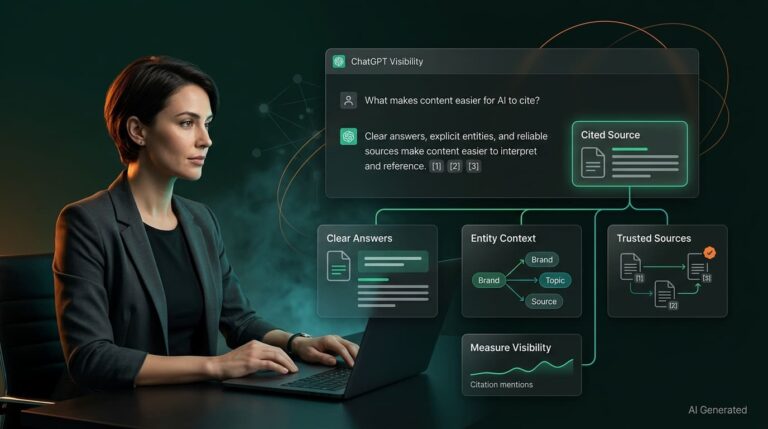

4 Comments