
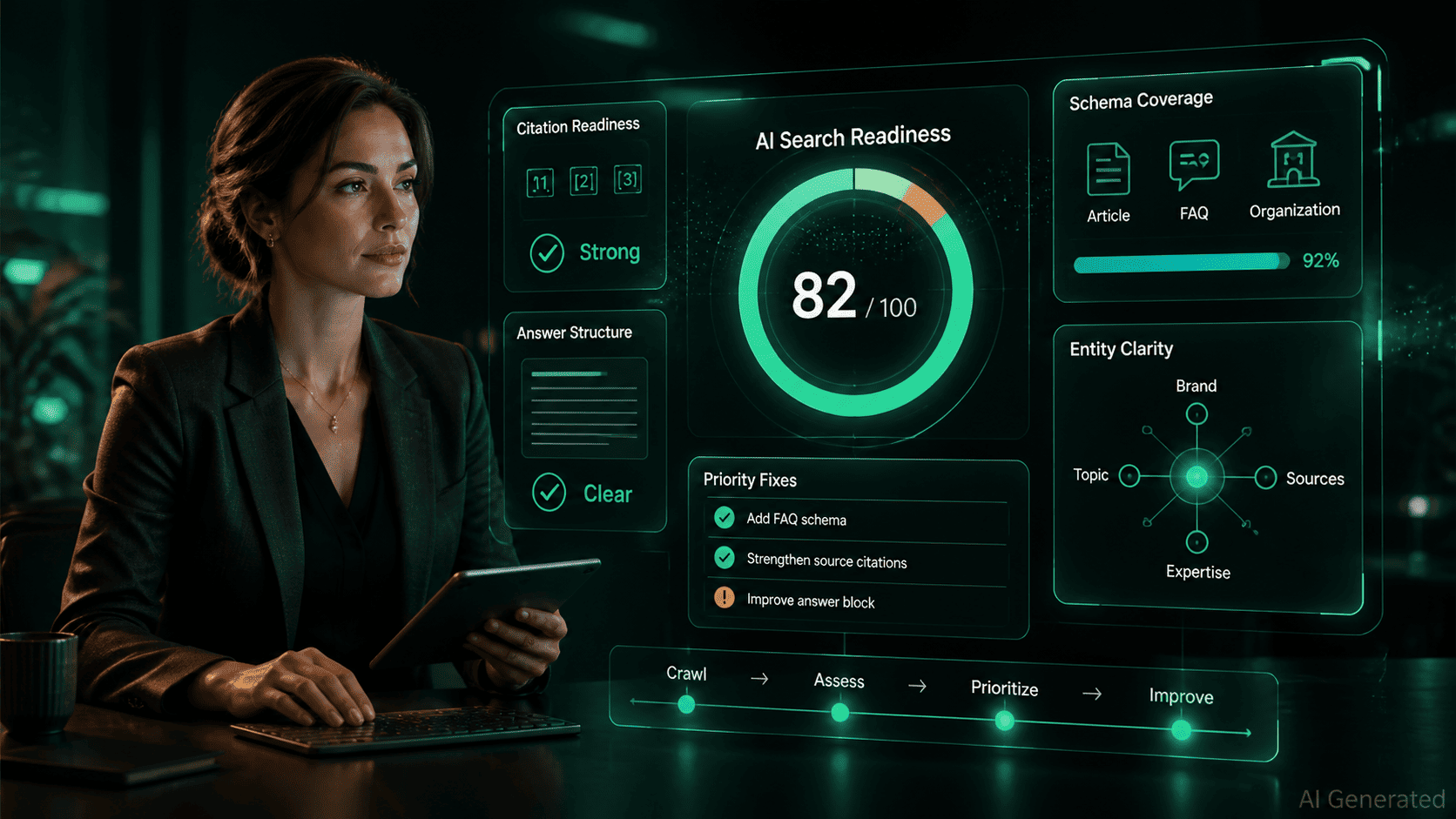
Quick answer: AI search readiness comes down to four independent layers — entity and answer clarity, schema and structured data, technical crawlability, and AEO-specific content structure like FAQ formatting. A site can pass three of the four and still get skipped by an AI Overview or ChatGPT citation because the fourth layer is broken. The fastest way to see where you stand is to run your URL through the AEO Readiness Checker, which scores all four layers automatically from a live fetch of your page.
Most technical SEO audits check crawlability and call it done. That was sufficient when the only thing consuming your content was a search engine crawler building an index. It isn’t sufficient now. Answer Engine Optimization (AEO) requires a fifth kind of reader — an LLM retrieval layer — to correctly parse what your page is answering, verify it against structured data, and decide whether to cite it. That reader fails silently. There’s no error message when an LLM skips your page for a competitor’s; you just don’t show up in the answer.
This guide breaks down what “AI search readiness” actually measures, why it has to be scored in four separate layers rather than one blended number, and the fastest way to check where your own site stands.
What AI Search Readiness Actually Measures
A single blended score hides which layer is actually broken. A site can have flawless technical SEO — fast, indexable, clean canonicals — and still fail to get cited because nothing on the page is formatted as a direct, liftable answer. Conversely, a site can have beautifully structured FAQ content and still fail because the schema markup that would surface it as FAQPage is missing or broken. Scoring the layers independently is the only way to see which one to fix first.
| Layer | What it checks |
|---|---|
| Entity & Answer Clarity | Whether content states what it’s about in terms a model doesn’t have to infer — explicit entity names instead of pronouns, a direct answer near the top, question-format headings |
| Schema & Structured Data | Whether the machine-readable layer backs up what the page says in plain text — Article, FAQPage, and Organization schema present and valid |
| Technical & Crawlability | The baseline every SEO audit already checks — indexability, Core Web Vitals, canonical hygiene, descriptive internal linking, HTTPS |
| AEO Content Structure | Format-level signals specific to AI citation — explicit FAQ blocks, comparison tables, visible freshness signals, verifiable external citations |
None of these four layers is optional. A high score in three categories doesn’t compensate for a failure in the fourth — an entity-clear article with broken schema still under-cites, and technically flawless pages with no FAQ structure or atomic answers still under-cite. All four need to pass together.
Entity & Answer Clarity: Why This Layer Fails Even on Well-Written Content
This is the layer that trips up genuinely good writers, because it isn’t about writing quality at all — it’s about whether the content states what it’s about in terms a model doesn’t have to infer. Skilled writers are trained to vary phrasing, use pronouns for flow, and build to a point rather than lead with it. All three of those habits work against a retrieval layer trying to quickly determine what a page answers.
Consider the difference between these two openings for the same article on GEO:
Weak for AEO: “It’s become increasingly important for content to be structured in a way that works well with the new generation of AI tools that have emerged over the past couple of years.”
Strong for AEO: “Generative Engine Optimization (GEO) is the practice of structuring content so Large Language Models like ChatGPT and Perplexity can accurately summarize and cite it.”
The second version names the entity (GEO), names the platforms it relates to (ChatGPT, Perplexity), and states a direct definition — everything the first version gestures at without ever committing to. Neither sentence is objectively “better writing.” The second is simply extractable in a way the first isn’t. The fix, in practice, is a five-minute pass on any existing article: read the first two sentences and ask whether a reader who saw nothing else would know exactly what the article is about, named specifically rather than implied.
Schema & Structured Data: The Gap Between “Present” and “Valid”
Most sites that fail this layer don’t have zero schema — they have schema that’s present but broken, which is a worse position than having none at all, because it signals to Google and other crawlers that the page’s structured data can’t be trusted. Common failure patterns: an Article schema block left over from a theme update that duplicates a second Article schema injected by an SEO plugin; a FAQPage schema block referencing questions that were later deleted from the visible page, so the schema and the content no longer match; an Organization schema pointing at a logo URL that changed during a site redesign eighteen months ago and was never updated.
None of these show up by glancing at the page. They show up by running the URL through Google’s Rich Results Test, which is the single fastest diagnostic for this layer and takes under thirty seconds per page. For the WordPress-specific question of which plugin actually catches these errors before they ship, see Rank Math Pro vs Yoast SEO: AEO and Schema Compared.
Technical & Crawlability: The Layer Everyone Thinks They’ve Already Solved
This is the layer with the most existing tooling and the most false confidence. A site that’s been through several rounds of traditional SEO work usually has functioning canonicals, a submitted sitemap, and passable Core Web Vitals — which is exactly why teams skip re-checking it when a citation problem shows up and assume the issue must be somewhere more exotic. It’s worth checking anyway, for one specific reason: robots.txt rules get edited far more often than anyone tracks, usually by a developer blocking a staging path or a plugin update that silently adds a disallow rule, and those changes don’t show up in a Core Web Vitals report at all.
The AI-specific wrinkle here is bot-specific blocking: a robots.txt file can allow Googlebot while silently disallowing GPTBot, ClaudeBot, or PerplexityBot — a configuration that looks completely normal in a standard technical audit and only surfaces if something is specifically checking for those user-agents by name.
AEO Content Structure: Before and After
This layer is the most format-driven of the four, which makes it the easiest to demonstrate concretely. Take a typical FAQ-adjacent paragraph buried inside body copy:
Before: “A lot of people wonder whether AI is going to make SEO obsolete, but that’s not really the right way to think about it — the discipline is evolving rather than disappearing, and there’s still plenty of room for practitioners who adapt.”
After (explicit FAQ format): “Is SEO dead because of AI? No. SEO has expanded into a three-discipline stack — traditional SEO, AEO, and GEO — rather than being replaced. Practitioners who adapt to all three maintain visibility; those who don’t lose ground specifically on informational queries.”
Same underlying claim, but the second version is a self-contained, liftable answer with the question stated explicitly — exactly the shape an FAQPage schema block and an LLM’s retrieval layer both expect. This is the single highest-leverage edit available to sites that already have decent prose but score low on this layer: find the places where you’re already answering a reader’s implicit question, and make the question explicit.
The Fastest Way to Check Your Own Score
Manually checking all four layers page by page is slow and easy to get wrong — especially schema validation and Core Web Vitals, which most people don’t check by hand at all. The AEO Readiness Checker automates it: paste in a URL and it fetches the live page, parses the actual DOM and robots.txt, and scores all four layers automatically — no signup required. It also supports a competitor comparison mode, so you can see exactly where your page is ahead or behind a specific competing URL on each layer, not just in aggregate.
That’s the practical starting point for everything in this guide: run your homepage or your highest-traffic article through the checker first, then come back to the sections below for what to do about whatever it flags.
How Often Should You Re-Run the Audit?
Once per new article at minimum, before it publishes rather than after — catching a missing FAQ block or a broken schema tag at draft stage costs five minutes; catching it in a site-wide audit six months later costs a rewrite queue. Beyond that, re-run it whenever one of three things happens: a theme or plugin update touches your SEO stack, since that’s the most common cause of a schema block silently breaking; a robots.txt edit for any reason, since a bot-specific disallow rule is easy to introduce by accident and invisible in every other report; or roughly quarterly on your highest-traffic pages regardless of whether anything changed, since content that scored well a year ago can drift as the surrounding site evolves around it.
What doesn’t need re-checking constantly: pages that scored 80+ and haven’t been touched. Chasing a perfect 100 across every page on a large site is a worse use of time than making sure your twenty highest-traffic pages are all above 80 — diminishing returns set in fast once the structural barriers are gone, and the remaining points come from marginal entity coverage rather than anything that meaningfully changes citation odds.
What to Fix First If Your Score Is Low
If Technical & Crawlability is the weak layer, fix that first regardless of what else is failing — nothing else matters if a crawler or an LLM’s retrieval layer can’t reliably reach the page. Indexability and Core Web Vitals come before anything AEO-specific.
If Schema & Structured Data is the weak layer, the gap is usually FAQPage or Article schema either missing or invalid. See Rank Math Pro vs Yoast SEO: AEO and Schema Compared for which WordPress plugin actually closes that gap and how each handles validation.
If AEO Content Structure is the weak layer — the most common gap for sites that have invested in traditional SEO for years — the fix is usually format, not information: add a direct-answer opening sentence, convert prose comparisons into an actual table, and add an explicit FAQ section with 3–6 liftable Q&A pairs. See Technical Foundations for AI-First SEO for the underlying technical patterns this connects to.
The pattern worth internalizing across all four layers: the fix is almost never a full rewrite. It’s a targeted, structural edit to content that’s already substantively correct. Teams that treat a low readiness score as a signal to start over waste far more effort than teams that treat it as a checklist of specific, additive changes — a Quick Answer paragraph inserted at the top, an FAQ block added at the bottom, a broken schema tag corrected in place. The underlying research and argument in a well-written article rarely needs to change; what needs to change is how explicitly that argument is labeled for something that’s skimming it in milliseconds rather than reading it.
Stay Ahead of AI Search.
Weekly AEO, GEO & AI SEO intelligence for marketers who want their content cited by AI. No fluff.
Frequently Asked Questions
The Bottom Line
AI search readiness isn’t one score, it’s four — and the layer you’d never think to check by hand (AEO Content Structure) is usually the one costing sites with otherwise-solid SEO their AI citations. Guessing which layer is weak wastes time; running the actual number takes under a minute.
Run your site through the free AEO Readiness Checker now to see your score across all four layers, then come back to the “What to Fix First” section above for the specific next step based on whichever layer comes back weakest.

Written by
AEO Insider Editorial Team
We help modern marketers and operators get their content cited by AI, discovered in search, and wired into scalable growth systems. Our collective focus is entirely on the cutting edge of AEO, GEO, and AI-native SEO.
ABOUT AEO Insider →