
Quick answer: Entity-first content means writing so that every concept a knowledgeable source would mention on a topic is actually present on the page — not just the target keyword repeated at density. AI systems assemble answers from entities and relationships, not word counts, so a page missing the entities a topic requires reads as thin to an AI model even when it’s well-written. The fastest way to find what’s missing is to compare your draft against a knowledge graph directly, using a tool like the free Entity & Knowledge Graph Gap Mapper, rather than guessing.
Most content teams still audit “topical coverage” by eye — reading a draft and asking whether it feels thorough. That instinct is unreliable in exactly the way that matters most for AI search. A page can read as complete to its own author while skipping the specific related concepts an AI system expects a genuine expert source to mention, because the author already knows those concepts and doesn’t notice their absence. The reader — human or model — doesn’t have that context. They only have what’s on the page.
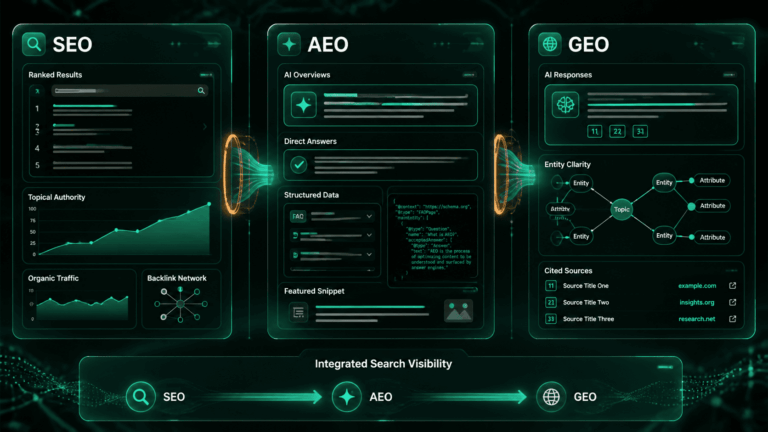
This is the practical half of the framework laid out in the Generative Engine Optimization (GEO) guide: GEO rewards entity clarity and information density, not keyword repetition. And it connects directly to the citation economy — AI models cite sources that demonstrate real command of a topic’s surrounding concepts, not sources that circle one phrase from every angle. Entity-first content is how you produce that command deliberately, instead of hoping your prose happens to cover the right ground.
What Does “Entity-First” Content Actually Mean?
An entity is a concrete thing: a part, a related process, a person, an organization, a product, a sub-concept — anything a knowledge graph like Wikidata or Google’s Knowledge Graph treats as a distinct, nameable node. Entity-first content means structuring an article around the full set of entities a topic requires, then writing the prose to explain each one’s relevance — rather than starting from a keyword and writing until it feels long enough.
The difference shows up clearest in a concrete example. An article on “espresso machines” that repeats the phrase fifty times but never mentions the portafilter, the grouphead, or bar pressure reads as keyword-optimized but topically shallow — to a human expert and to an AI system evaluating what the page actually covers. An article that names those parts and explains what each one does reads as authoritative before anyone judges the writing quality, because the entities themselves signal domain command.
Why Do AI Systems Reward Entity Coverage Over Keyword Density?
Search engines have modeled content as networks of entities for years — Google’s Knowledge Graph exists specifically to understand pages this way rather than as bags of words. Generative AI systems extend the same logic into answer construction: an AI model assembling a response draws on the entities and relationships a page demonstrates it understands, then decides whether that page is worth citing as a source.
A topically thin page — correct but narrow — gives an AI system little beyond the exact sentence it already wrote. A page that surrounds its core answer with the entities a knowledgeable source would naturally mention gives the model more surface area to draw from, and more reason to treat the page as a credible reference rather than a single fact to extract and discard. This is the same principle behind writing blog content for AI SEO — density of genuine information matters more than density of a target phrase.
How Do You Find the Entities Your Content Is Actually Missing?
Manually brainstorming “what else should this page cover” runs into the same blind spot every time: you can’t reliably notice the absence of something you didn’t think to include. The more reliable approach is to compare your draft against a structured knowledge graph directly, rather than against your own memory of the topic.
That’s what the free Entity & Knowledge Graph Gap Mapper does. Enter your topic and paste your content, and it resolves the topic to its Wikidata entity, pulls everything Wikidata connects to it through a curated relationship set — instance-of, subclass-of, part-of, has-part, and similar — ranks those related entities by how prominently Wikipedia documents them, and checks which ones your text already mentions. The output is a Topical Completeness Score and a ranked, specific list of what’s missing, instead of a vague sense that the page could probably be more thorough.
Because it queries Wikidata directly rather than asking an AI model what a topic “should” include, the result is reproducible — the same topic returns the same expected entities every time, rather than a different answer depending on which model you ask or how you phrase the question.
How Should You Prioritize and Close Entity Gaps Once You Find Them?
Not every missing entity deserves equal attention, and treating a gap list as a flat checklist tends to produce padded, unfocused additions. Work in priority order instead:
- Start with the highest-ranked missing entities. They’re ranked by prominence for a reason — these are the concepts most people researching the topic would expect addressed somewhere on the page.
- Give each addition real explanatory context, not a passing mention. A single sentence that names a missing entity without explaining its relevance to the topic barely moves a page’s actual coverage, even if it technically “closes” the gap on a checklist.
- Group related gaps into one new section rather than scattering them. If three missing entities are all facets of the same sub-topic, they usually belong together, not spread across three disconnected sentences.
- Re-run the check before calling it done. Confirm the score actually moved. Adding a related term in passing doesn’t always register the same way as genuinely covering the concept — and the gap mapper is free to re-run as many times as needed.
- Use judgment on very low-prominence gaps. Not every entity a knowledge graph connects to a topic is worth its own section — some are administrative, dated, or only tangentially relevant. Prominence ranking is a strong signal, not an absolute rule.
How Does Entity Coverage Fit Into the Rest of the AEO/GEO Workflow?
Entity coverage answers one specific question: does this content address the concepts the topic requires? That’s necessary but not sufficient. A page can mention every expected entity and still be written in a way that an AI retrieval system wouldn’t actually surface for a real reader’s question — coverage and retrievability are genuinely different problems. Once a page’s Topical Completeness Score is solid, the next step is checking whether individual paragraphs are structured so a retrieval-based AI system can actually find and quote them, which is what LLM optimization and content retrievability covers using a real embedding-based simulator.
Treat the two checks as sequential, not interchangeable: confirm topical coverage first, then confirm retrievability. A rewrite that improves one can still leave the other unaddressed, so re-running both after a major content update is worth the two or three minutes it takes.
Stay Ahead of AI Search.
Weekly AEO, GEO & AI SEO intelligence for marketers who want their content cited by AI. No fluff.
Frequently Asked Questions
The Bottom Line
Entity coverage is the part of AEO and GEO that’s easiest to get wrong by instinct alone, because the gaps are invisible to the person who already knows the topic. Checking against a structured knowledge graph — rather than a mental checklist — turns “cover the topic more thoroughly” into a specific, ranked, checkable list, and doing it costs nothing and takes a few seconds per run.
Run your next draft through the free Entity & Knowledge Graph Gap Mapper before publishing, close the highest-priority gaps with real context, and then move on to confirming whether your paragraphs are actually retrievable — coverage and retrievability are both prerequisites, and neither one substitutes for the other.

Written by
AEO Insider Editorial Team
We help modern marketers and operators get their content cited by AI, discovered in search, and wired into scalable growth systems. Our collective focus is entirely on the cutting edge of AEO, GEO, and AI-native SEO.
ABOUT AEO Insider →