
Quick answer: You can’t rank in ChatGPT the way you rank on Google, because ChatGPT doesn’t return a ranked list. It retrieves pages and cites a few. To get cited, allow OAI-SearchBot in your robots.txt, get indexed in Bing and Google, write self-contained answer paragraphs, earn third-party mentions, and keep content fresh. Check crawler access first with the free Robots.txt AI Bot Auditor.
Most guides on this topic open with a promise that sounds like traditional SEO: follow these steps and you will “rank” in ChatGPT. That framing is the first thing worth correcting. A ChatGPT answer is not a results page. It is a generated response that sometimes includes links to a handful of sources, and which sources appear can change from one prompt to the next. What you are optimizing for is eligibility, retrievability, and trust, not a position number.
That distinction matters because it changes where you spend time. Rankings on Google reward a page that beats other pages for a keyword. Citations in ChatGPT reward a page that can be fetched, indexed, understood, and quoted accurately, and a brand that other sources also mention. This guide walks through the five layers in the order I check them when I audit a site, and links the free tools on AEO Insider that test each layer. If you want the broader theory first, read The Citation Economy and LLM Optimization: How to Make Content Model-Friendly.
What Does “Ranking in ChatGPT” Actually Mean?
ChatGPT builds an answer from two pools of knowledge. The first is its training data, a static snapshot of historical web content that changes only when a model is retrained. You cannot meaningfully influence that on a timescale of weeks. The second is live retrieval: when ChatGPT’s search feature is used, it fetches current pages, reads them, and cites the ones it relied on. Live retrieval is the part you can influence, and it is where almost every actionable step in this guide sits.
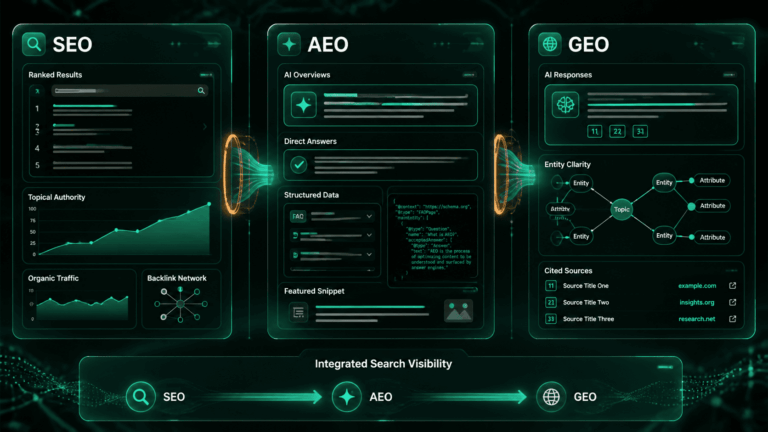
Two consequences follow. First, there is no stable “position one.” Kevin Indig’s H1 2026 analysis for Search Engine Land argues that tracking AI visibility is closer to polling than to rank tracking, because results vary by engine, personalization, and model version, and he reports that 91% of citations appear in only one of ChatGPT, Perplexity, or AI Overviews. Second, optimizing for ChatGPT is not the same project as optimizing for Google AI Overviews, even though the foundations overlap. Plan for each surface separately and measure each one separately.
Step 1: Do You Allow OAI-SearchBot in robots.txt?
Start here, because everything else is wasted if ChatGPT’s search crawler cannot reach your pages. OpenAI runs three separate user agents, and robots.txt files go wrong when site owners treat them as one “OpenAI bot.” OpenAI’s crawler documentation describes each one, and the table below summarizes what matters for visibility.
| Crawler | What it does | Controlled by robots.txt? | If you block it |
|---|---|---|---|
| OAI-SearchBot | Indexes pages so they can be surfaced in ChatGPT’s search results | Yes. OpenAI says to use this token for search opt-outs and automatic crawling | Your pages are not eligible to appear in ChatGPT search answers |
| GPTBot | Collects content that may be used to train OpenAI’s models | Yes | You opt out of training only. It does not remove you from ChatGPT search |
| ChatGPT-User | Fetches a page when a user asks ChatGPT to open a link or take an action | OpenAI notes robots.txt rules may not apply, because the action is user-initiated | Not a reliable control. Don’t build your strategy around it |
The practical takeaway is that you can block training and still be searchable. A configuration that does exactly that looks like this:
# Allow ChatGPT search to retrieve and cite your pages
User-agent: OAI-SearchBot
Allow: /

# Optional: opt out of model training only
User-agent: GPTBot
Disallow: /

# Allow user-requested fetches
User-agent: ChatGPT-User
Allow: /

# Everyone else: protect admin paths only
User-agent: *
Disallow: /wp-admin/
Allow: /wp-admin/admin-ajax.php
Whether to block GPTBot is a business decision, not an SEO one. If you are a publisher who objects to training use, blocking it is legitimate and does not cost you search visibility. If you want maximum exposure and have no objection, leave it open. What you should not do is block OAI-SearchBot by accident, which usually happens in one of three ways: a blanket User-agent: * with Disallow: / left over from staging, a security plugin that adds bot rules without telling you, or a CDN or firewall that challenges unfamiliar bots even though robots.txt allows them. OpenAI publishes IP ranges for its crawlers, so if your firewall is the suspect, check the logs against those ranges rather than guessing.
To test this in under a minute, paste your domain into the Robots.txt AI Bot Auditor. It parses your live robots.txt against 21 AI crawlers, including all three OpenAI agents, and generates fix code for anything blocked. One caveat on how to read its score: the auditor treats several bots as critical, but for ChatGPT search specifically, OAI-SearchBot is the entry that decides eligibility.
Step 2: Is Your Content Indexed Where ChatGPT Retrieves From?
Crawl access gets a bot to your door. Retrieval also depends on the search indexes ChatGPT draws from, and OpenAI does not publish a full list. Several industry analyses report heavy overlap between ChatGPT’s live search results and Bing’s, and the Semrush guide to ChatGPT search recommends confirming indexing in both Google and Bing. I’d treat that as an inference rather than a documented fact: Bing indexing is the step I would not skip, and Google indexing is the sensible hedge.
The actions are straightforward and cost nothing:
- Verify your site in Bing Webmaster Tools and confirm your key pages show as indexed. Many sites that are well indexed in Google have never been submitted to Bing.
- Submit your XML sitemap to both Google Search Console and Bing. A clean sitemap with only canonical, indexable URLs helps every crawler.
- Consider IndexNow, the protocol Bing supports for notifying search engines when a URL is added or updated. On WordPress, SEO plugins such as Rank Math can send these pings for you.
- Check for accidental noindex tags and canonical conflicts on the pages you most want cited.
The AEO Readiness Checker flags indexability and canonical problems as part of its Technical Access score, so it is a quick way to catch the noindex and canonical issues on a specific URL.
Step 3: Can a Model Lift a Clean Answer From Your Page?
Once your page is reachable and indexed, the next question is whether any single passage on it works as an answer by itself. Retrieval systems typically work with passages rather than whole pages: they match a question to the most similar chunk of text, then the model composes its response from what was retrieved. A page can be excellent as a whole and still lose, because no individual paragraph is self-contained enough to be quoted.
Here is the same idea written two ways. The first buries the answer and leans on a pronoun. The second names the subject and answers directly:
Hard to retrieve: “This is why it matters so much for teams who have already invested in the older approach, and it changes how they should think about what comes next.”
Easy to retrieve: “OAI-SearchBot is the OpenAI crawler that decides whether your pages can appear in ChatGPT search results. Blocking GPTBot does not affect it.”
Four habits produce this consistently. Lead each section with the direct answer, then add context. Name the entity in the sentence rather than relying on “this” or “it.” Use question-format headings that mirror how people actually prompt (“How do I allow OAI-SearchBot?”). And cover the sub-questions around your main topic. Practitioner write-ups such as the seocrawl guide to ranking in ChatGPT describe this as query fan-out: the model decomposes one prompt into several supporting searches, so a page that answers the sub-questions can be retrieved even when it does not rank for the main phrase. Treat that as a working model, not an official specification.
Two free tools help here. The Entity Gap Mapper shows which concepts a strong page on your topic should cover that yours doesn’t. The Real Retrieval Simulator runs an open-source embedding model in your browser and shows which of your paragraphs match realistic reader questions. It is a proxy for retrieval behavior in general, not a simulation of ChatGPT’s internal system, so use it to find weak paragraphs rather than to predict a specific citation.
Step 4: Does the Web Mention Your Brand Outside Your Own Site?
This is the step most on-page checklists skip, and it is the hardest to fake. Language models are cautious about claims that only one source makes. Brands that appear across independent sources, such as industry roundups, review sites, community discussions on Reddit and Quora, and credible publications, give a retrieval system corroboration. Several studies report that third-party mention volume correlates with how often a brand is cited. That is a correlation, and it does not prove that adding mentions will cause citations, but it matches how retrieval is designed to behave. Indig’s H1 2026 analysis makes the related point that brand mentions inside AI answers can matter more to business outcomes than the citation links themselves.
What this means in practice:
- Keep your entity consistent. Use the same brand name, description, and founder or author details on your site, LinkedIn, and any directory or profile you control.
- Earn inclusion in “best of” and comparison content that real people read, rather than paying for placements that read as advertising.
- Publish something worth citing: original data, a named framework, or a free tool. Pages that contain facts no one else has give other writers a reason to reference you.
- Show real authorship. A named author with credentials and a bio is easier for both readers and models to trust than an anonymous byline.
Step 5: Is Your Content Current and Verifiable?
Freshness and verifiability are the two trust signals you fully control. On freshness, the Semrush guide cited above notes that one study found recency bias across several LLMs, with newer content tending to surface more often. The safe reading is that stale pages on fast-moving topics carry a risk. Show a real publication date and an honest modified date, and only update the modified date when the content actually changed. Faking freshness by bumping timestamps is easy to detect and undermines the trust you are trying to build.
On verifiability, cite your sources, link to primary documentation, and avoid precision statistics you cannot source. A claim like “our method improves citations by 43%” with no data behind it is worse than no claim. The same rule applies to this article: where a point is an inference rather than a documented fact, it is labeled as one.
| Layer | What to check | Free tool |
|---|---|---|
| Crawl access | OAI-SearchBot allowed in robots.txt; no firewall challenge | Robots.txt AI Bot Auditor |
| Indexing | Indexed in Bing and Google; no stray noindex or canonical conflicts | AEO Readiness Checker |
| Passage quality | Self-contained answers; entities named explicitly | Real Retrieval Simulator |
| Topic coverage | Concepts and sub-questions a strong page would include | Entity Gap Mapper |
| Trust signals | Real author, dates, cited sources, third-party mentions | AEO Readiness Checker |
How Do You Measure Your Visibility in ChatGPT?
There is no rank tracker for ChatGPT in the Google sense, so measurement has three parts. The first is referral traffic. Links in ChatGPT’s search answers often carry a utm_source=chatgpt.com parameter, so filter for that source in GA4 and cross-check against your server logs. Expect an undercount, since some visits arrive without referrer information and land in Direct. The second is a prompt panel: write 10 to 20 realistic questions your customers would ask, run them on a regular schedule, and record whether your brand is mentioned, whether your URL is cited, and in what context. Because answers vary, treat each run as a sample and look at trends across weeks, not single results. The third is crawler logs: confirm that OAI-SearchBot is actually requesting your pages, using OpenAI’s published IP ranges to rule out spoofed user agents.
For a fuller measurement setup, see KPIs for AI-Native SEO and GEO, and for dedicated tracking software, 12 Best Tools for GEO and AI Overviews Optimization.
What Doesn’t Work for Getting Cited in ChatGPT?
Keyword stuffing is the clearest failure. The original 2023 research on generative engine optimization (Aggarwal et al.) found that repeating keywords did not help visibility in generative answers, while adding credible quotations, statistics, and cited sources did. Hidden text, mass-produced pages, and fake freshness all fall in the same category: they try to manipulate a system that is built to check claims against other sources. Guarantees are the other red flag. Nobody outside OpenAI can promise a citation, and any service that does is selling certainty that does not exist.
Stay Ahead of AI Search.
Weekly AEO, GEO & AI SEO intelligence for marketers who want their content cited by AI. No fluff.
Frequently Asked Questions
The Bottom Line
Ranking in ChatGPT is a stack, not a trick. Crawler access decides eligibility, indexing decides whether you are in the pool, passage quality decides whether a model can quote you, and third-party mentions and freshness decide whether you are trusted enough to be chosen. The order matters because the earliest broken layer cancels everything after it, and the earliest layer, robots.txt, is also the quickest to check.
Run your domain through the free Robots.txt AI Bot Auditor now, then score a key page in the AEO Readiness Checker. Fix whichever layer comes back weakest, and measure again in a few weeks with a fixed set of prompts.

Written by
AEO Insider Editorial Team
We help modern marketers and operators get their content cited by AI, discovered in search, and wired into scalable growth systems. Our collective focus is entirely on the cutting edge of AEO, GEO, and AI-native SEO.
ABOUT AEO Insider →