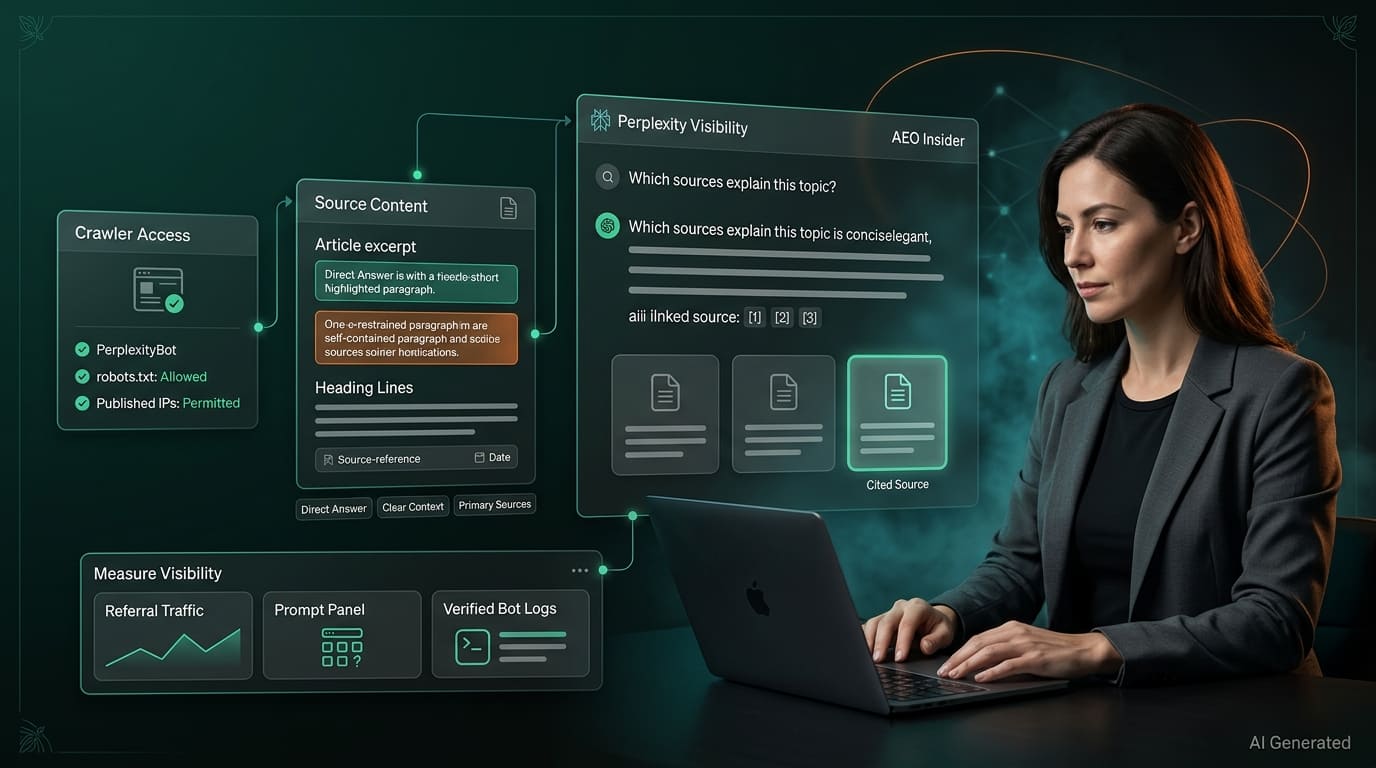
Quick answer: Perplexity is a retrieval engine. It indexes pages with PerplexityBot, then cites the sources it uses in an answer. Perplexity’s own guidance is short: allow PerplexityBot in robots.txt and permit its published IP ranges. Everything beyond that, including freshness, tables, and structure, is practitioner inference rather than documentation. So confirm access, write answer-first passages with sources, keep content current, and measure with referral data and a prompt panel.
Most guides on ranking in Perplexity read like settled science. They quote precise percentages about which pages get cited, which formats win, and how much backlinks matter, and the numbers often contradict each other from one guide to the next. Perplexity publishes very little about how it selects sources, so a lot of that confidence has nothing underneath it.
This guide takes a different approach. It separates what Perplexity documents from what practitioners infer, and labels each claim accordingly. The goal is the same as in our guides to ranking in ChatGPT and ranking in Google AI Overviews: give you steps you can verify, in the order that stops wasted effort.
What Does Ranking in Perplexity Actually Mean?
Perplexity answers a question in prose and attaches citations to the sources it relied on. There is no results page with ten blue links and no fixed position to hold. The unit of success is being one of the cited sources, or being named inside the answer, for the questions your buyers ask. Which sources appear changes with the question, the wording, and time.
That variability has a measurement consequence. Kevin Indig’s H1 2026 analysis for Search Engine Land argues that tracking AI visibility resembles polling more than rank tracking, and reports that 91% of citations appear in only one of ChatGPT, Perplexity, or AI Overviews. A page that is cited in Perplexity is not necessarily cited elsewhere, so plan and measure each engine separately.
Step 1: Do You Allow PerplexityBot and Perplexity-User?
This is the one step Perplexity documents clearly. Its crawler documentation lists two user agents, and they do different jobs.
| User agent | What Perplexity says it does | robots.txt behavior |
|---|---|---|
| PerplexityBot | Designed to surface and link websites in search results on Perplexity. Perplexity states it is not used to crawl content for AI foundation models | Perplexity recommends allowing it in robots.txt and permitting its published IP ranges |
| Perplexity-User | Supports user actions within Perplexity. Not used for web crawling or to collect content for training | Because a user requested the fetch, it generally ignores robots.txt rules |
A configuration that allows both looks like this:
# Allow Perplexity to index and cite your pages
User-agent: PerplexityBot
Allow: /

# Allow user-requested fetches
User-agent: Perplexity-User
Allow: /
Robots.txt is only one layer. Perplexity’s documentation also describes a Cloudflare WAF rule that matches the PerplexityBot and Perplexity-User user agents, and publishes IP lists for each at perplexity.com/perplexitybot.json and perplexity.com/perplexity-user.json. If your firewall or CDN challenges unfamiliar bots, those ranges are what you allow.
There is one complication worth knowing about. In August 2025, Cloudflare publicly alleged that Perplexity used undeclared crawlers to get around no-crawl rules, and delisted Perplexity as a verified bot. Perplexity denied the claims. I can’t adjudicate that dispute, but it has two practical implications. If you want to block Perplexity, robots.txt alone may not be enough, so use firewall rules. If you want to be cited, check that bot-management rules on Cloudflare or a similar service aren’t silently challenging PerplexityBot even though your robots.txt allows it. That second point is an inference from the delisting, so confirm it in your own firewall logs.
To test your robots.txt for both agents in under a minute, paste your domain into the Robots.txt AI Bot Auditor.
Step 2: Can PerplexityBot Read Your Page Without JavaScript?
Perplexity’s documentation does not say whether PerplexityBot executes JavaScript, so assume it might not. The safe practice is to make sure your main content, headings, and key facts are present in the HTML your server returns, not injected afterward by scripts. Open view-source on a key page and search for a sentence from your answer paragraph. If it is missing, a crawler that reads raw HTML will not see it either.
The AEO Readiness Checker reads static HTML in the same way, so a page that scores poorly on content because it is script-rendered is telling you something real. Also confirm the page is not marked noindex and that its canonical points to itself.
Step 3: Does Each Section Open With a Quotable Answer?
Perplexity builds an answer by pulling passages from several pages and attributing them. A passage can only be pulled if it makes sense on its own. Lead each section with the direct answer in one or two sentences, name the subject instead of leaning on “this” or “it,” and put the supporting detail after. A short summary box near the top and comparison tables for “X vs Y” questions are common recommendations in practitioner guides. Treat them as reasonable formatting for any reader, not as documented Perplexity ranking rules.
Two free tools help with the editing. The Entity Gap Mapper shows which concepts a strong page on your topic should cover that yours doesn’t. The Real Retrieval Simulator shows which of your paragraphs match realistic questions. It is a general proxy for retrieval, not a simulation of Perplexity’s system, so use it to find weak paragraphs rather than to predict a citation. For the underlying approach, see LLM Optimization: How to Make Content Model-Friendly.
Step 4: Is Your Content Current and Verifiable?
Many vendor guides state that Perplexity strongly favors recently published or updated content. I could not find a ranking-factor list in Perplexity’s documentation that confirms this, so it is a plausible practitioner observation rather than a documented rule. It is also good practice regardless. Show a real publication date and an honest modified date, update pages when the facts change, and cite primary sources for any figure you state.
The verifiability point matters more than the freshness point. An answer engine that cites sources is exposed when a source is wrong, so claims with a traceable origin are safer to cite than round numbers with no source. The same standard applies to guides about Perplexity itself: the percentages you see repeated across vendor articles rarely trace back to a methodology you can check.
Step 5: How Do You Measure Visibility in Perplexity?
Perplexity has no equivalent of Search Console, so measurement is assembled from three sources. The first is referral traffic: look for perplexity.ai as a source in GA4 and compare it against your landing pages. The second is a prompt panel. Write 10 to 20 realistic questions your customers would ask, run them on a regular schedule, and record whether your brand is mentioned and whether your URL is cited. Treat each run as a sample, since answers vary. The third is your server logs: confirm PerplexityBot is actually requesting pages, and verify it against the IP list Perplexity publishes so spoofed user agents don’t inflate your numbers.
Keep one lesson from the recent ChatGPT tracking problem in mind. Search Engine Land reported that ChatGPT’s UTM parameter went missing for about a week in October 2026, pushing AI referrals into Direct. AI referral data is fragile, so annotate anomalies in your analytics and avoid conclusions from a single week. For a wider measurement framework, see KPIs for AI-Native SEO and GEO.
Should You Block Perplexity?
That depends on whether you want to be cited there. Perplexity states PerplexityBot is for search and is not used to crawl content for foundation model training, so blocking it does not opt you out of training in the way blocking a training crawler would. It does remove your pages from Perplexity’s search results, which means no citations. If your content is licensed or paywalled and you object to its reuse in answers, blocking is a legitimate choice, but enforce it with firewall rules as well as robots.txt, for the reason covered in Step 1.
Which Perplexity Claims Are Documented and Which Are Not?
| Claim | Status |
|---|---|
| Allow PerplexityBot in robots.txt to appear in results | Documented. Perplexity recommends it |
| Permit Perplexity’s published IP ranges | Documented. Perplexity publishes the lists |
| Perplexity-User generally ignores robots.txt | Documented by Perplexity, because the fetch is user-initiated |
| PerplexityBot is not used for model training | Stated by Perplexity |
| Perplexity favors fresh content | Practitioner claim. Not found in Perplexity’s documentation |
| Comparison tables and summary boxes get cited more | Practitioner claim. Reasonable formatting, unverified as a ranking factor |
| Specific percentages, such as how few cited URLs rank in Google’s top 10 | Vendor figures that conflict across sources. Methodology not verifiable here |
| Backlinks decide who gets cited | Conflicting vendor claims. Not documented |
Stay Ahead of AI Search.
Weekly AEO, GEO & AI SEO intelligence for marketers who want their content cited by AI. No fluff.
Frequently Asked Questions
The Bottom Line
Ranking in Perplexity comes down to a short list of things you can verify and a longer list of things people claim. Verify access first, because it is the only part Perplexity documents: PerplexityBot allowed, its IP ranges permitted, nothing in your firewall quietly challenging it. Then write passages that stand alone, keep facts current and sourced, and measure with a fixed prompt panel instead of single checks. Be skeptical of any guide that gives you a precise percentage without showing where it came from.
Start with the free Robots.txt AI Bot Auditor to check both Perplexity user agents, then score a key page in the AEO Readiness Checker.

Written by
AEO Insider Editorial Team
We help modern marketers and operators get their content cited by AI, discovered in search, and wired into scalable growth systems. Our collective focus is entirely on the cutting edge of AEO, GEO, and AI-native SEO.
ABOUT AEO Insider →